Uncategorized

The Work and Travel Tax Refund Myth: “You’ll Get It All Back” and Other Stories Sold to Students

The Work and Travel tax refund myth

Hello to everyone who has already reclaimed every tax dollar in their head, paid off the program fee, and bought a triumphant ticket to New York.

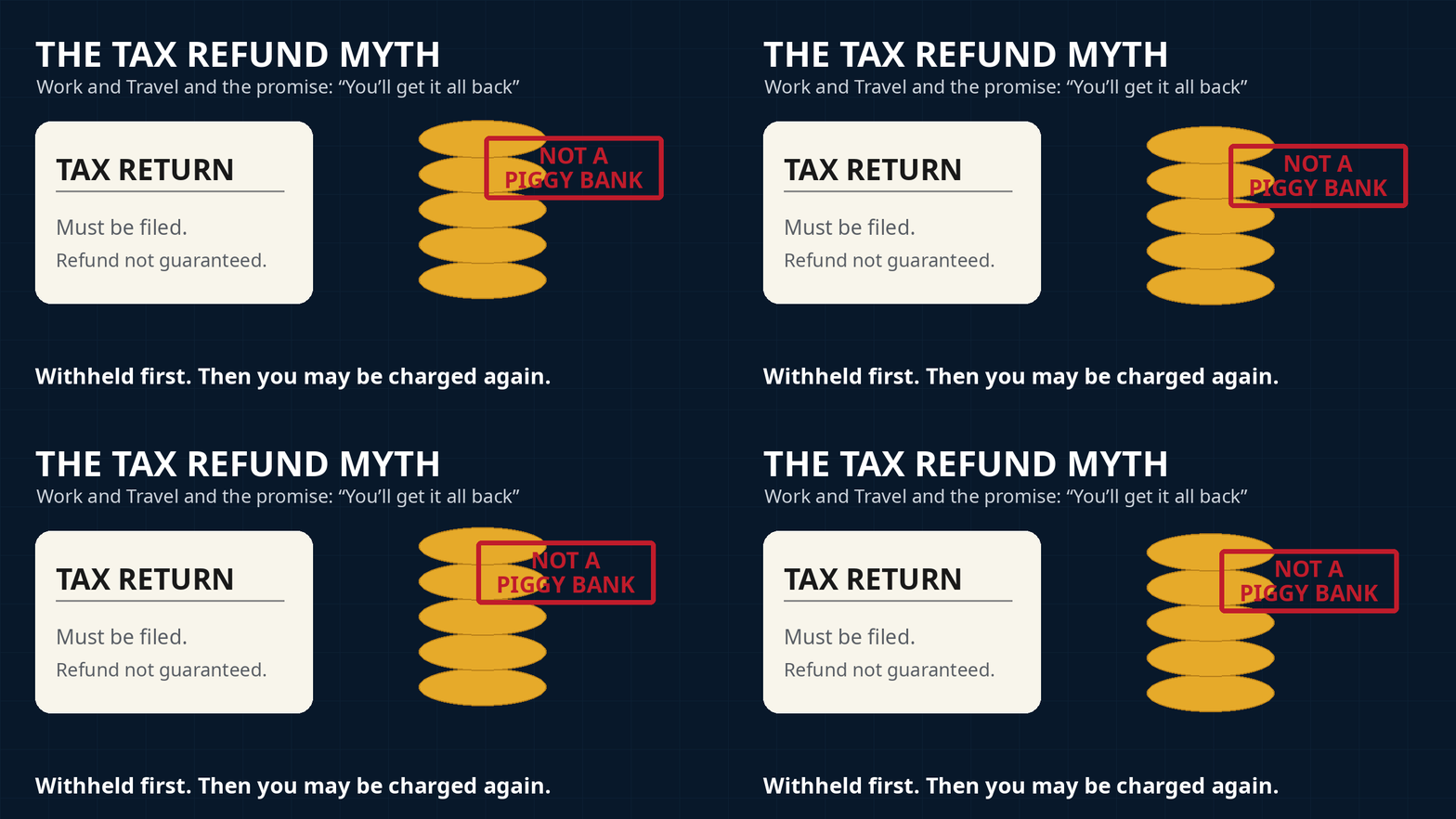
Here comes another unpleasant conversation. Not because taxes are boring. Taxes are actually simple: money was withheld, so there is less money in your paycheck. The unpleasant part is the sales pitch. For years, Work and Travel participants have been sold the comforting story that almost everything taken from their wages will come back after the trip.

“Don’t worry. You are not a U.S. citizen, so you’ll get your money back later.” It sounds confident. At an agency meeting, it almost sounds caring. In a message, it can sound like free money.

Then the student comes home, opens the paperwork, and discovers a filing fee, a mandatory tax return, federal tax, state tax, the 2018 reform, deadlines, and a fresh collection of “helpers.” At that point, the agent’s reassuring smile starts to look remarkably expensive.

Myth No. 4: “A tax refund is my own hard-earned money, so I will get every cent back.”

You may get a small part back. You may get almost nothing. You may even pay the same people who previously promised to “help.” A neat little recycling program for student money.

Original Russian book cover used in the source article

From the source article. The original Russian book cover for the series of articles about the Work and Travel program.

A tax return is not the same thing as a refund

Start with the basic distinction. Having to file a tax return and having the right to receive money back are two different things. Completely different. This is also where students are most often confused.

The source article describes filing a tax return as a required part of the U.S. tax system for Work and Travel participants from 2018 onward. But a required form does not create a guaranteed refund. A tax return is not a “give me my money” button. It reports how much you earned, how much was withheld, your tax status, and what the final calculation says.

That calculation may be disappointing—especially if the student has already decided that the U.S. tax authorities were merely keeping the money in temporary storage and are now expected to return it with a ribbon.
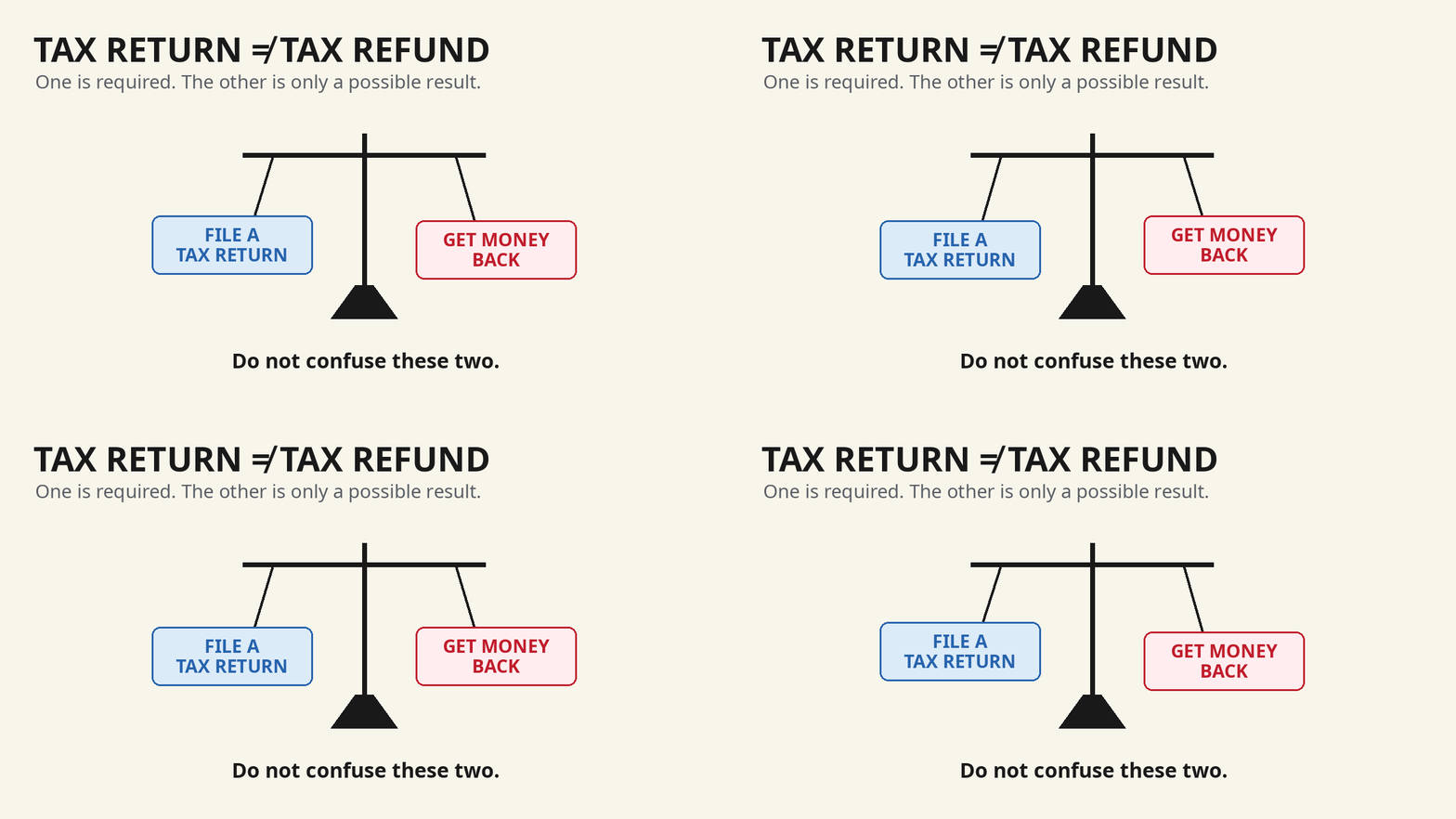
A tax return is not the same as a tax refund

In one sentence. You may have to file a return. Nobody has promised that money will come back.

When an agent says, “We will help with your taxes,” ask what that means. File the return? Check the withholding? Recover federal tax? Recover state tax? Or collect $100–$150 and ceremonially send you home to wait?

If the answer suddenly becomes vague, you asked the right question.

Where did the “you’ll get it all back” myth come from?

The myth is convenient for everyone except the student.

It helps the agent sell the program because the promised refund appears to reduce the true price of the trip. It reassures the parents because some of the cost will supposedly return. It comforts the student because a difficult summer can still be imagined as a profitable one.

In conversation, it sounds something like this:

“I was told not to worry about taxes because I would get everything back later. Once I got home, I learned that nobody had guaranteed a refund—and I had to pay extra for help with the paperwork.”

(Anna, 2026)

That is the whole trick. Before the student pays for the program, taxes are presented as money that will only be held for a while. After the trip, the student discovers a separate paperwork problem—and another bill.

If you have already read the myth about earnings, you can see why this tax story matters. When the entire trip depends on recovering the thousands of dollars spent just to get there, even a promised $300–$400 refund starts to look like a lifeline.
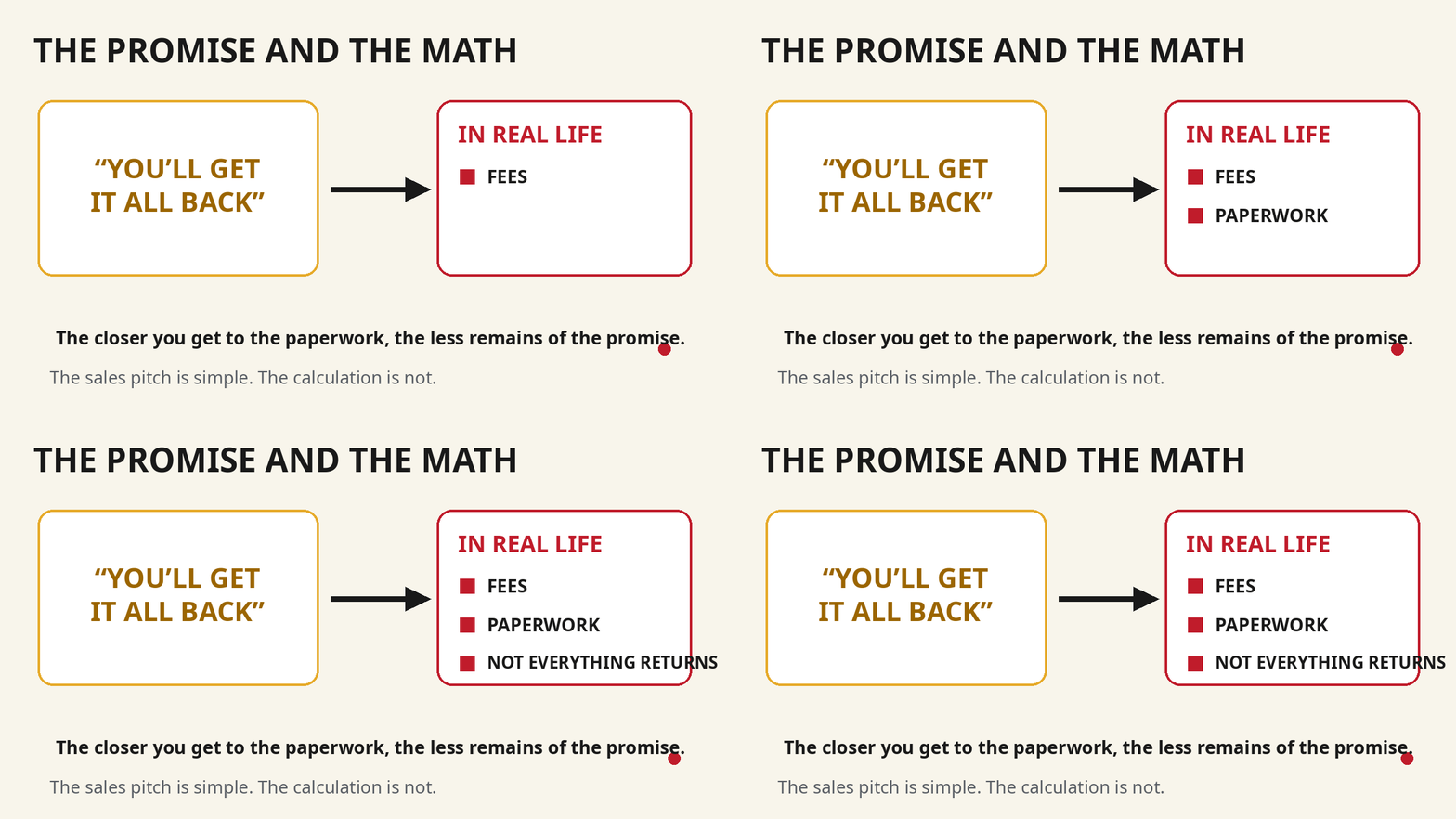
The promise of a full tax refund compared with the actual calculation

The promise and the calculation. The closer the student gets to the paperwork, the less remains of the beautiful phrase “you’ll get it all back.”

How much was withheld—and how much may actually come back?

The source article gives a simple example: over one summer and one job, roughly $400–$500 may be withheld from a student’s pay. That is enough money to make anyone want it back. Then comes the dull but honest part.

Intermediaries may charge about $100–$150 or more to handle the refund. Sometimes it is a flat fee. Sometimes it is a share of whatever comes back. Meanwhile, the refund itself may be only $50–$100. The student stops asking, “How much will I receive?” and starts asking, “Why did I get involved in this at all?”

The promise and the actual calculation
“I will recover every dollar withheld”
You may recover far less than everything.
“It is my money, so they have to give it back”
Once it is withheld, it is part of a tax calculation—not your wallet sitting in a safe.
“The agent will help”
That help may cost $100–$150 or more.
“The refund will cover part of the program”
After the filing fee, the amount left may be almost comical.

States differ. Withholding differs. Employers and final amounts differ. None of that changes the central point: “you’ll get it all back” is not guaranteed income and should never be placed in the trip budget as if it were.

Why 2018 matters

The source article places particular emphasis on the 2018 tax reform. It says personal exemptions disappeared for Work and Travel participants and that, after the reform, federal income tax on earnings up to $9,525 became the main reason the old story of a full refund no longer matched the arithmetic.

This is where the unpleasant math begins. According to the article’s explanation, the federal portion represents roughly 90% of the total withholding. That largest portion is also where the main post-2018 problem appeared.

State taxes remain, but they are smaller, vary by state, and are not always refundable. Paying a $100 fee in an attempt to recover $90 is not tax planning. It is a game of “find the catch,” played with your own money.
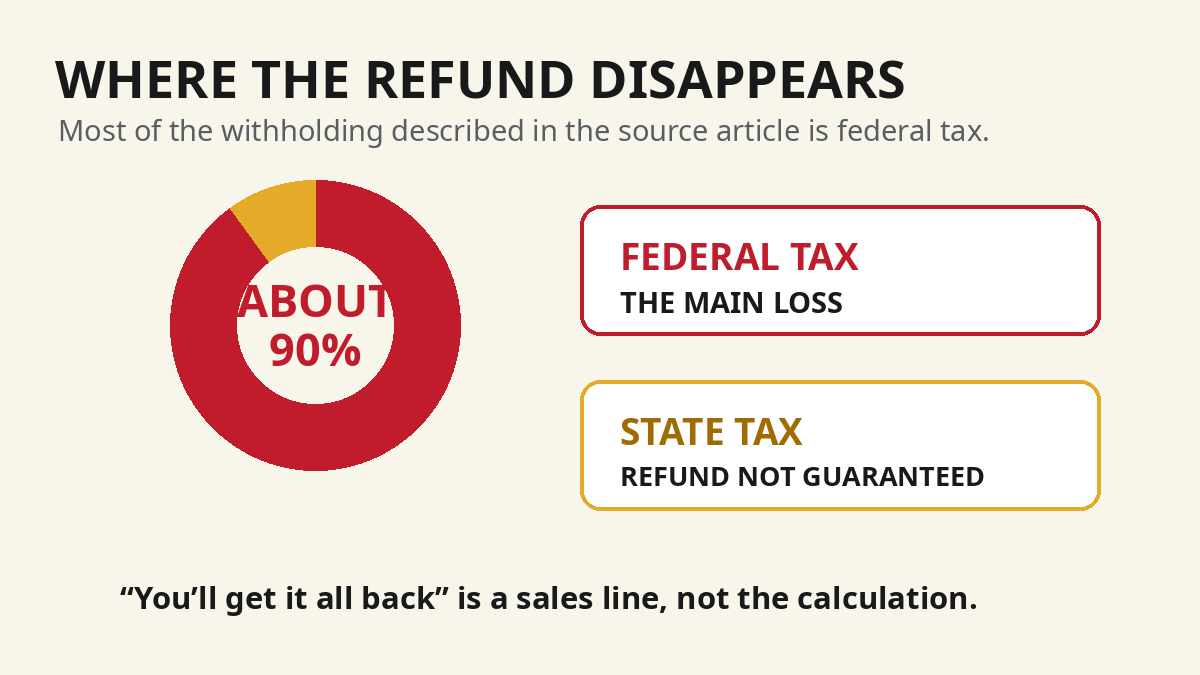
Federal and state portions of tax withholding for a Work and Travel participant

The source article’s main point. Most of the withholding is federal tax, and that is where the central post-2018 problem lies.

“Tax specialists” and the new checkout counter after the trip

As the old myth began to crack, a convenient new service appeared. Students were directed to intermediaries who supposedly knew how to recover everything. Officially, they were helpers. In practice, they became another checkout counter on the student’s route.

The sales pitch is easy. American tax forms look intimidating. The agent says, “We have people who will take care of everything.” Those people promise a result. The student hands over documents, pays, and hopes that anyone calling themselves a specialist knows what they are doing.

The problem is that the return is filed in the student’s name. Not the agent’s name. Not the “helper’s” name. Not the name of the friendly person smiling across an office desk. The student’s name.

The worst part: if the paperwork uses the wrong tax status or treats the student as a U.S. tax resident, the questions may later be addressed to the student—not the person who collected the fee.

The source article describes that danger directly: intermediaries may recover federal tax by telling the U.S. tax authorities that Work and Travel participants are residents. The student celebrates the refund, the intermediary takes a fee, the agent keeps selling the program, and the risk stays with the person whose name and signature are on the documents.
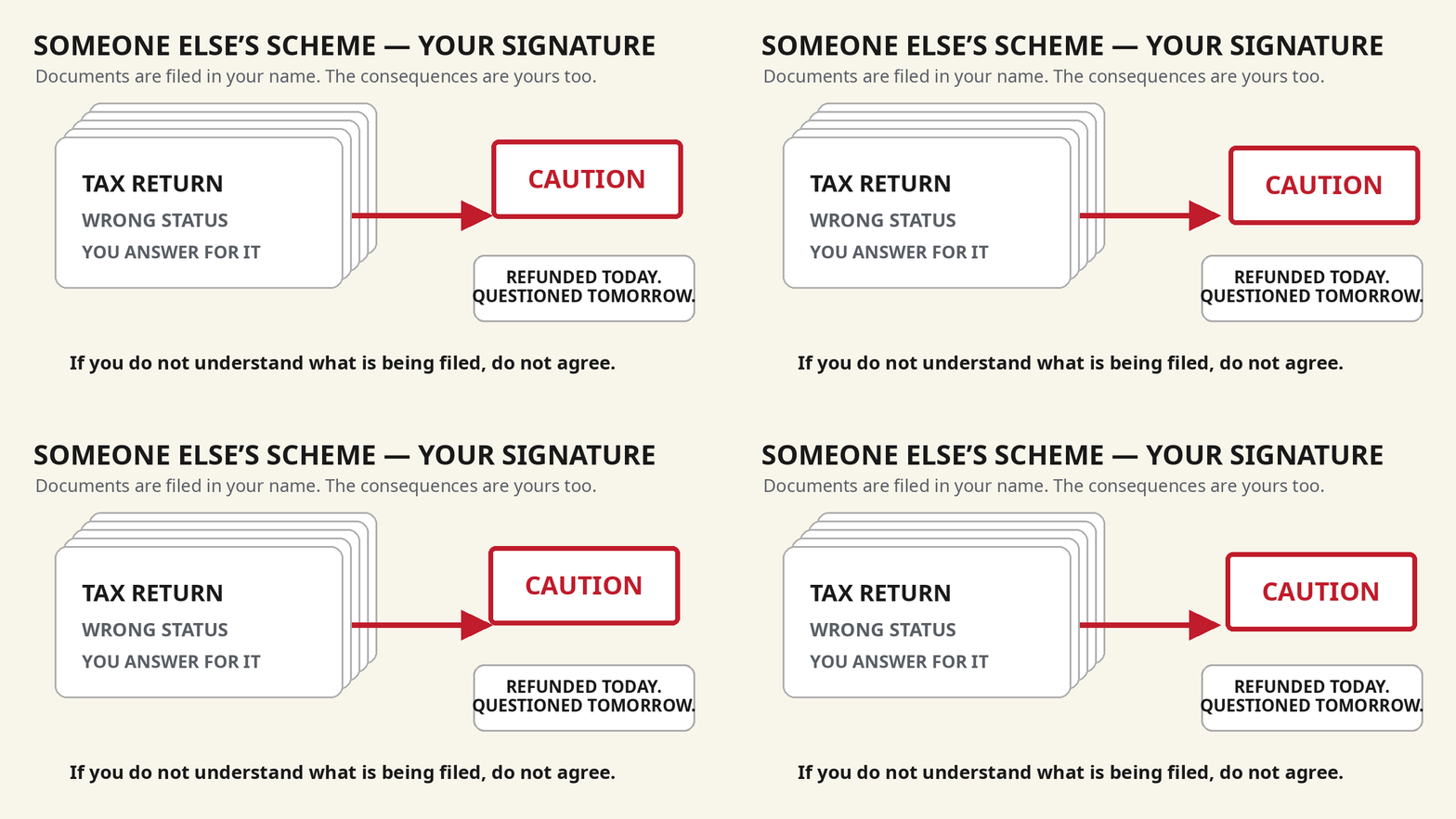
Someone else’s tax scheme and the student’s responsibility

The rule that matters. If you do not understand what is being filed in your name, do not pretend everything is fine.

The $1,200 payment: when old “help” came back to visit

The source article gives a telling episode. In 2020, many former Work and Travel participants—including Russian students—received pandemic-related payments of $1,200 from the U.S. Treasury. For some, it was unexpected money. For others, it was a reason to panic.

Why? The article’s explanation is that some students had previously used questionable “helpers” to recover federal tax. If a return had been filed as though the student were a U.S. tax resident, the system could continue treating that person as a resident. Then came a payment many of them had never expected.

First, excitement. Then questions. Then silence from the people who had once recommended “reliable specialists.”

The same old arrangement: the agent sold the program, the intermediary collected the money, and the student inherited the consequences.

Tax refund fraud warning based on the source article’s illustration

From the source article. Its section about tax-refund fraud is not decoration. It is a warning.

Why agents dislike this conversation

Because an honest conversation about taxes makes the program harder to sell.

Imagine telling a room of prospective participants: “You probably will not recover part of the tax. Filing may cost extra. The return may be mandatory, but a refund is not guaranteed. And questionable methods can create problems in your name.” Is it a beautiful sales speech? Not particularly. Will students rush to pay? Also not guaranteed.

It is much easier to rely on reassuring phrases:

  • “Do not worry; we will help with the taxes.”
  • “You are foreigners, so a lot of it will come back.”
  • “Just keep all the documents.”
  • “We will handle everything after the trip.”
  • “We have trusted people.”

None of those sentences sounds like an obvious lie on its own. Together, however, they create a false impression that taxes are an almost guaranteed addition to the student’s earnings. It is ordinary advertising dressed in accounting language.

That is why this tax myth belongs beside the myth about improving your English, the career myth, the cultural-exchange myth, and the article about how U.S. employers profit from participants. The picture becomes less cheerful—but considerably closer to real life.

Quick check: should you believe the refund promise?

Open each question and look at where the unpleasant part of the conversation usually hides.

The agent says: “You’ll get all your taxes back”

Ask for a written list of the exact taxes: federal, state, and local. A general answer is not a calculation. It is a sales conversation.

The agent says: “We’ll help you file”

Ask what the help costs, who files the return, and in whose name. “We’ll help” without a price is not yet help.

You are promised a full federal-tax refund

Stop and ask for the legal basis. If someone wants to file as though you were a U.S. tax resident, do not treat that detail as harmless.

You are told: “Everyone does it”

That is a favorite line in questionable schemes. When the consequences arrive, “everyone” tends to disappear.
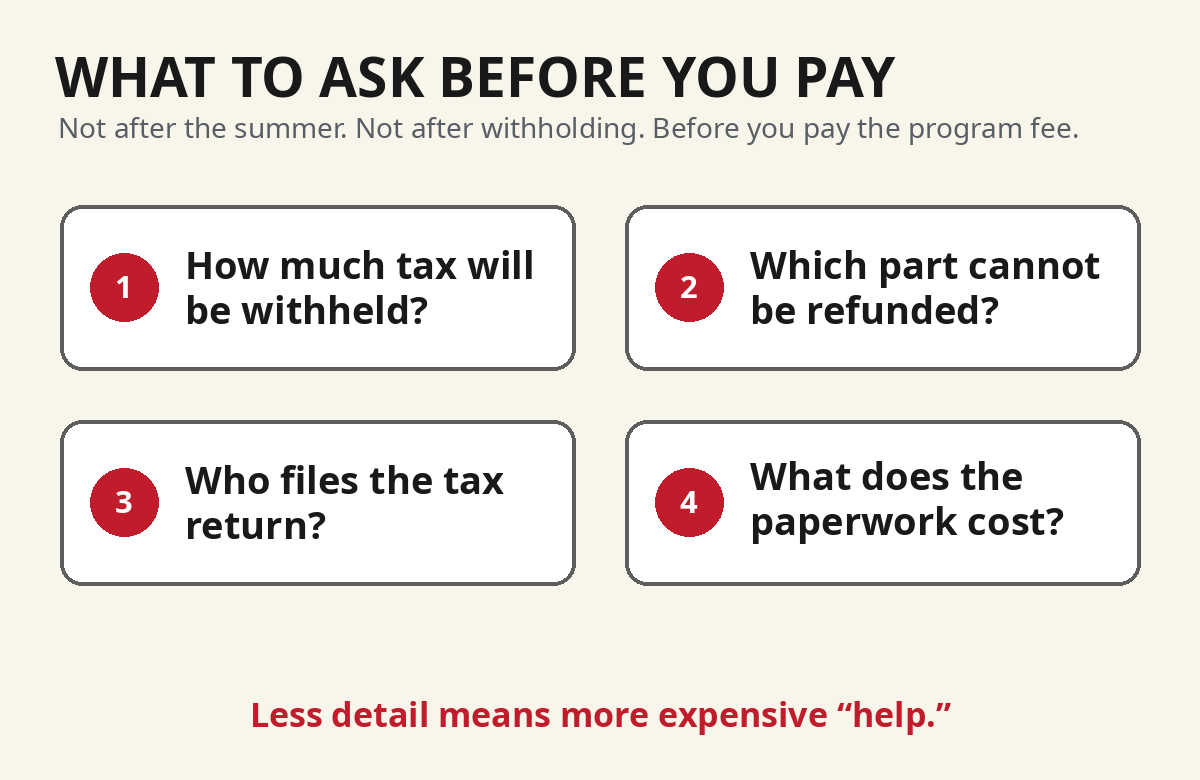
Four tax questions to ask the agent before paying for the Work and Travel program

Save this list and show it to your parents.A good agent will answer these questions calmly and in writing. A bad one will steer the conversation elsewhere.

What the student needs to remember

First: taxes are not a future gift. Do not budget a refund as guaranteed income.

Second: filing a return and receiving a refund are not the same thing. Many people must file paperwork; far fewer are guaranteed money back.

Third: the tax-refund service may cost so much that the refund stops making financial sense.

Fourth: do not allow strangers to file documents in your name when nobody has explained what those documents say—especially when your tax status is involved.

Fifth: if the agent cheerfully promises “you’ll get everything back” before you pay for the program, ask for that promise in the contract, in plain language. Not in a friendly message. Not verbally. Not “we always help.” In writing: what comes back, what the service costs, and who is responsible if there is no refund.

This is usually where the room becomes quiet.

Reaction to the promise of a full tax refund

From the source article. Roughly the moment a student realizes that “you’ll get it all back” was bait, not a calculation.

The bottom line: withheld tax is not your backup wallet

The most honest formula is this: withheld tax is no longer your backup wallet. The money has entered the U.S. tax system. Some of it may come back. Some may not. Filing may cost extra. And questionable “help” can produce future trouble instead of money.

Do not build the trip around a promised refund. Build it around a sober calculation with no miracles included: the program fee, realistic earnings, housing, food, transportation, insurance, taxes, and all the other “small details” the agent somehow remembers only after payment.

If the trip still makes sense after that calculation, good—you are at least going with your eyes open. But if the entire financial case depends on “you’ll get the taxes back later,” stop now and read this article again.

Later will be too late. The money will be gone. The documents will be signed. And the agent will say the usual line: “We warned you. You simply misunderstood.”


We also publish veeeery useful articles and other excerpts from our book:


Important

This article is intended for readers aged 18 and over and provides only a general overview. It is not legal or tax advice. Before filing any documents, verify the current requirements and consult an independent professional when necessary.

Copyright © 2026. All rights reserved.

Uncategorized

The Work and Travel Travel Myth: “I’ll See America in One Summer”

Work and Travel myth about seeing America in one summer

“I’ll go to America, work a little, and then travel around the country.”

Sounds familiar? Of course it does. The name of the program practically begs you to imagine travel first and work second. A student hears “Work and Travel” and immediately sees the ocean, New York, long roads, photos, sunsets, and classmates back home quietly turning green with envy.

Beautiful picture. Too beautiful.

Let’s remove the postcard filter. In WAT, travel is often not the main part of the summer. It becomes a small note at the end: if money is left, if the schedule allows, if the second job does not eat the weekend, if there is someone to go with, if you still have the strength, if school does not pull you back too soon. That is a lot of “ifs” for something sold as a dream.

We have already looked at why the promised English practice often turns into a few work phrases, a noisy kitchen, and conversations in your native language at home. The travel myth works in almost the same way. On paper: America. In real life: work, commute, shared housing, fatigue, and the repeated question: “So when exactly am I supposed to see the country?”

Today we are taking apart another WAT myth: “I’ll see America in one summer.”
Not because travel is impossible. It is possible. But only if you understand in advance that the program is built first around work, costs, and the interests of the people making money from your participation.

Myth No. 7: “The main thing is to get to the U.S.; the rest will work itself out”

This is the most convenient thought an agent can put into a student’s head. They are not selling a detailed travel plan, a realistic schedule, or an honest budget. They are selling a mood: “You’ll be in America! You’ll figure it out there.”

No, my friend, you may not. In a foreign country, after a kitchen or hotel shift, without a serious money cushion and without real free time, “I’ll figure it out” quickly becomes “I just need to reach the bed tonight.” Especially when you did not come for a tour. You came for low-paid seasonal work, the same work discussed in the career and international-experience myth.

Agents love smiling faces, cities, beaches, and open roads. That is understandable: selling a dream is easier than selling a sink full of dirty dishes. But the program is not built around your future photos. It is built around summer labor. You are not brought in so you can admire the country. You are brought in to fill simple, heavy, low-status seasonal jobs: kitchen, cleaning, retail counter, amusement park, warehouse, hotel, boxes, floors, dishes, “bring this,” “carry that,” “do it again.”

And this is where the unpleasant part begins. After eight, ten, sometimes twelve hours on your feet, a trip to another city often loses to food, laundry, and sleep. Very romantic, isn’t it?

The Work and Travel myth series continues
Figure 1. The advertising dream is always brighter than the work shift. Before paying, read the program analysis, not the sales promise.

Why “I’ll see America” often becomes “room — work — store”

The problem is not that America is large. The problem is that your summer is small. A student tries to squeeze too much into a few months: earn money, pay back the program cost, return a family loan, find a second job, improve English, avoid fights with roommates, keep documents safe, stay healthy, keep the job, and still travel across the country.

Does that sound like a plan? No. It is a bag of expectations into which the seller has placed everything that helps close the sale.

The site’s main page makes the same point in a more general way: before paying thousands of dollars, it is worth reading the WAT myths and calmly estimating what is actually waiting for you. The articles on money, work, cultural exchange, program cost, and real participant reviews are not random. They form a normal order: count first, dream second.

Look at a typical day without the brochure shine. Morning: commute to work. Then the shift. Then, if you are lucky or desperate enough, a second shift or the search for one. Then food, laundry, messages home, roommates, sleep. On a day off, the great desire is not discovery. It is to stop being tired. Half the summer passes, and your “travel experience” is the nearby store, the laundromat, and one photo next to a sign.

Real workday during Work and Travel

Figure 2. A real photo from the site. This is the side from which the “trip” can begin long before the ocean and skyscrapers.

WAT geography: they promise a country, but sell a seasonal shift

The clever advertising trick is to mix two different things: being physically in the United States and actually traveling through the United States. Yes, you may be in America. That does not mean you will be seeing America.

You can spend the whole summer in one resort town where your world is the job, the room, the nearest store, and the bus stop. You can live with other students to save money, speak your own language at home, and use five short phrases at work. You can look at America for three months through a bus window on the way to a shift. Formally, you went abroad. In practice, you worked inside a small circle.

This does not mean trips never happen. They do. But they do not appear by magic. They require money, days off, a decent schedule, a route, tickets, people you trust, and a clear understanding that your employer is not obligated to protect your dream of nice travel photos.

Brochure map and working map during Work and Travel

Figure 3. The brochure map is wide. The real map often closes into a small loop: room, bus, shift, store, sleep.

Money: the main enemy of spontaneous travel

Now the boring part. Which means the important part.

Suppose you really want to travel. Fine. With what money? Not imaginary money from a sales presentation, but the money left after housing, food, transport, phone, uniform, deposits, household expenses, taxes, and all the little costs that somehow stay quiet during the cheerful consultation.

The money myth already shows the uncomfortable arithmetic: big earning promises sound loud, while an ordinary week after taxes and expenses looks much smaller. A separate article on how much WAT costs goes through the payments students and families often underestimate before signing.

This is why the question “Where will I go?” must come after “How much will I actually have left?” If your answer is “I don’t know, I’ll figure it out there,” you are not planning a trip. You are holding on to an advertisement.

The funny and sad part is that a student may save on normal food, live in a cramped room, take extra shifts, get exhausted, and then say, “Maybe we should cancel the big-city trip; it is too expensive.” Of course it is. When the program has already eaten the family’s savings, spending more money suddenly becomes painful.

Where a Work and Travel summer disappears

Figure 4. Summer feels long only before the first full workweek. After that, days start disappearing fast.

Days off: the most expensive currency of the summer

Even if money appears, there is a second question: when will you go?

In the sales version, it sounds easy: work, take a few days off, travel. In real life, days off depend on the employer, the season, staffing, roommates, transport, and whether you are brave enough to risk fewer hours. If you have two jobs, the puzzle becomes even worse. One job gives you Tuesday off; the other wants you on Tuesday. Congratulations: you have “free time” on paper only.

Many students also postpone travel until the end: “We’ll work first, then go.” Sometimes this works. Sometimes the end of summer turns into panic: tickets are expensive, the job ends late, school starts soon, someone in the group has no money, someone gets sick, someone changes plans, and the dream route shrinks to one rushed stop and a night bus.

This is why travel must be counted like an expense, not imagined like a reward. If you want three days in New York, then where are those three days in the calendar? What do they cost? What work hours are you losing? Where will you sleep? How will you get there? What happens if the bus is late? These are not boring questions. These are the questions that separate a real trip from a pretty thought.

The phrase “cultural exchange” does a lot of heavy lifting

WAT sellers love the phrase “cultural exchange” because it sounds noble. But if your “exchange” consists of low-status work, cramped housing, conversations with the same students, and constant saving, then let us be honest: this is not exactly the picture from the sales meeting.

The cultural-exchange myth is discussed separately on the site. Here the point is narrower: travel is often used as the sweet wrapper. Nobody says, “Pay thousands of dollars to become cheap seasonal labor for three months.” They say, “You will see America.” Feel the difference?

Parents often feel it too, but too late. At first it seems their child is going for experience, language, travel, and independence. Then it turns out that most of the experience is practical survival: finding a corner to sleep in, getting to work, not spending too much, not losing the job, not getting sick, and making it to the next paycheck.

Some people do grow up through that experience. Fair enough. But then say it honestly: “I am going to do hard seasonal work and may be able to travel a little.” That is honest. “I am going to travel and work a bit on the side” is the sales fairy tale.

When travel actually works

To keep the picture fair: yes, some participants do travel. Some see several cities. Some save in advance, plan the end of work, buy tickets without panic, choose decent travel partners, and return with good memories. This happens.

But it is usually not a gift from the program. It is the result of discipline. That kind of student understands before departure how much the program costs, what job they are taking, where they will live, how much they can save, what risks exist, when the season ends, and what to do if the plan goes sideways. They do not wait for the agent to arrange a beautiful summer. They count, check, and ask inconvenient questions.

That is why the site separately discusses categories of participants. Some go with fog in their head. Others go with calculations. The first group is later shocked that reality did not match the brochure. The second group at least understands what it has entered.

If you want to travel, do not plan “America.” Plan one or two real trips. Not ten cities from a dream picture, but a specific route. Not “I’ll negotiate somehow,” but actual days. Not “I’ll earn it there,” but money already set aside for transport and housing. And always keep a reserve in case the job gives fewer hours or the expenses rise.

What parents should ask

Parents should not be shy about boring questions. Yes, the student may roll their eyes: “Mom, Dad, please don’t start.” Start. The money is often family money, the risk is often family risk, and the sales promises somehow always sound very confident.

Ask directly:

  • Where exactly will the job and housing be?
  • How long is the commute to work?
  • How many people will live together?
  • What expenses are not included in the program price?
  • How much money is needed for the first weeks?
  • What happens if the employer gives fewer hours than promised?
  • When, exactly, will travel happen, and with what money?
  • Who helps if there is a dispute with the employer?

If the answers are vague, if everyone smiles and moves the conversation back to “but it is America,” then you are not looking at a plan. You are looking at a sale. And the student pays for that dream with real money.

Questions to ask before paying for Work and Travel

Figure 5. If the answers are vague before payment, they will not magically become precise after payment.

Also read the article on how much agents and sponsors make. After that, many warm sales smiles begin to look much more practical.

A quick self-check before paying

Open this if you still think the travel part will “work out somehow.”

If you cannot name your first real travel route, the expected cost, the days in the calendar, and the money left after required expenses, you do not yet have a travel plan. You have a hope.

Hope is not bad. Paying thousands of dollars on hope alone is.

Bottom line: you can go, but not with your eyes closed

This article is not saying: stay home and fear the world. No. Seeing the world is useful. Working abroad can also be useful. Understanding another country from the inside can be a strong experience, if you do not confuse experience with a sales postcard.

But if you go through WAT, do not lie to yourself. The main part of the program is work. Travel is possible, but it is not guaranteed, not already paid for, and not automatically protected by anyone. You will pay for it with money, time, strength, and sometimes lost work hours.

So the real question is not “Will I see America?” The real question is: “What exactly will I be able to see after shifts, expenses, commuting, and daily problems?”

If the answer is clear, good. If the answer is foggy, take off the rose-colored glasses, open the articles, count the money, and only then decide.

And when an agent again says that your summer will be unforgettable, do not argue. Just ask: how many consecutive days off will I have, how much money will remain after required expenses, and who gives written help if the job or housing is not as promised?

That is usually where the sales song ends.


Want to earn the promised “average” $6,000, get “international company experience,” improve English, and still travel around the country? Good luck… but before paying thousands of dollars to WAT agents, read the other materials on this site. Here are veeeery useful articles and excerpts from our book:

  1. The WAT money myth
  2. The WAT English-practice myth
  3. The WAT career and international-experience myth
  4. The WAT tax-refund myth
  5. The WAT health-insurance myth
  6. The WAT cultural-exchange myth
  7. J-1 visa interview: more than 100 common questions
  8. Why do students bring buckwheat to America?
  9. Sex. Money. WAT. Part one
  10. Sex. Money. WAT. Part two
  11. Niga, do you have a dollar?
  12. What does the press say?
  13. Murders and rapes of WAT participants
  14. Greedy Yankees, or how American companies profit from WAT students
  15. “Cheated by America,” or how the State Department and agents made money during the pandemic
  16. Russian WAT Roulette: program overview
  17. Main categories of participants, or what awaits me in America?
  18. Real participant reviews of WAT
  19. The global WAT class-action lawsuit
  20. How much does WAT really cost?
  21. How much do foreign WAT agents and sponsors make?
  22. The WAT setup: how students got 30 years in an American prison
  23. The dark side of WAT: how much agents sell students’ personal data for
  24. “Embarrassing and silly” — why Western Europeans do not go on WAT
  25. J-1 internship: another trap or something worthwhile?

These articles break down the most common WAT myths. It would be wise to read them before handing over the money, wouldn’t it?

Running bear

It is too late to run from the arithmetic after you have already paid. Open it before signing.

Disclaimer

This material is for general information and for readers 18 and older. It is not legal advice and not a personal recommendation. Decisions about travel, program payment, work, visa, insurance, and expenses are the reader’s own responsibility.