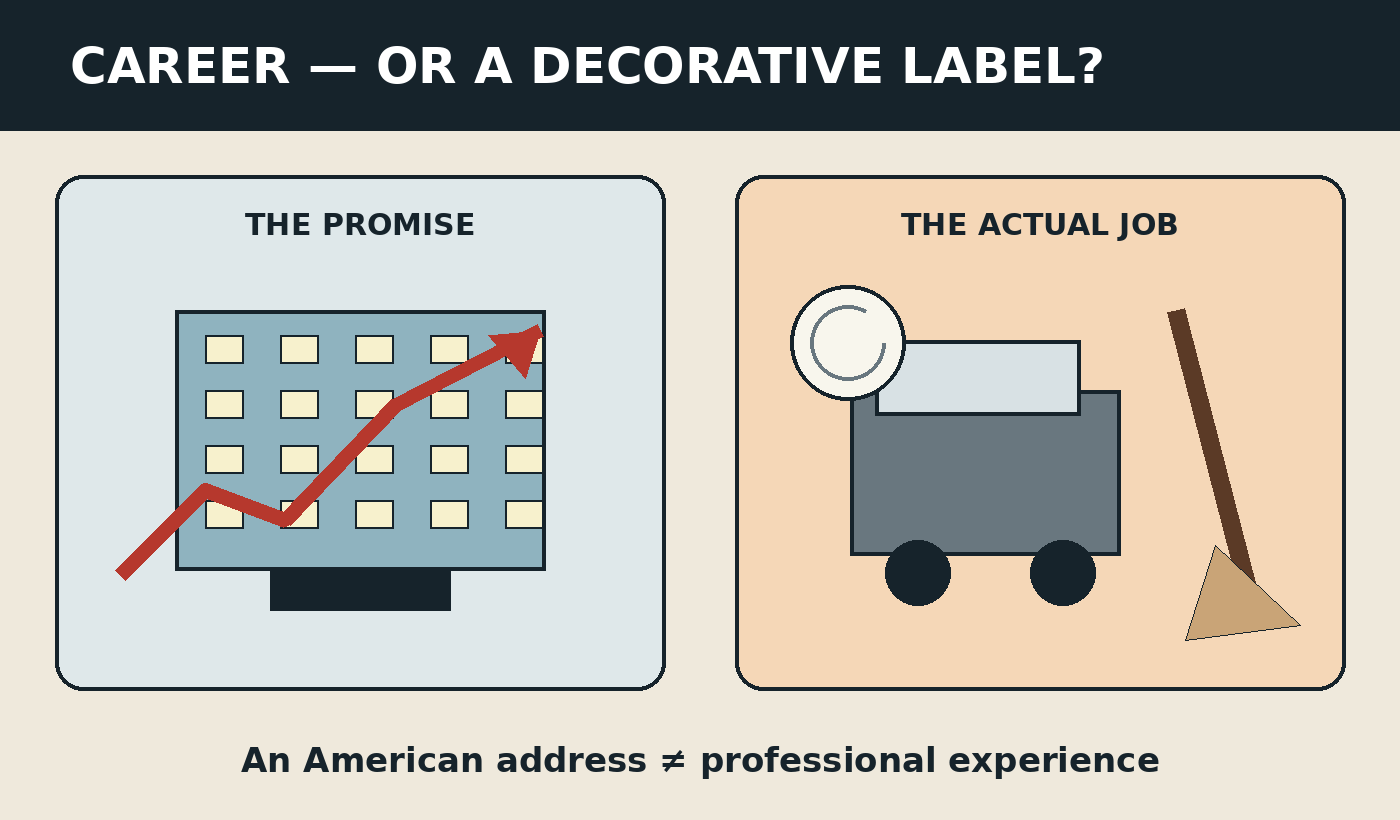
“Three months in an international company, and your career will take off.”
It sounds impressive. You can almost hear the elevator opening on the executive floor while future employers compete to hire you.
Now turn off the presentation music and read the job title.
Housekeeper. Dishwasher. Cashier. Cleaner. Fast-food helper.
Suddenly the “international career” smells less like a boardroom and more like detergent and hot cooking oil. There is nothing shameful about honest work. The problem is the sales trick: a seasonal job is presented as professional training, and an American address is presented as proof of future career value.
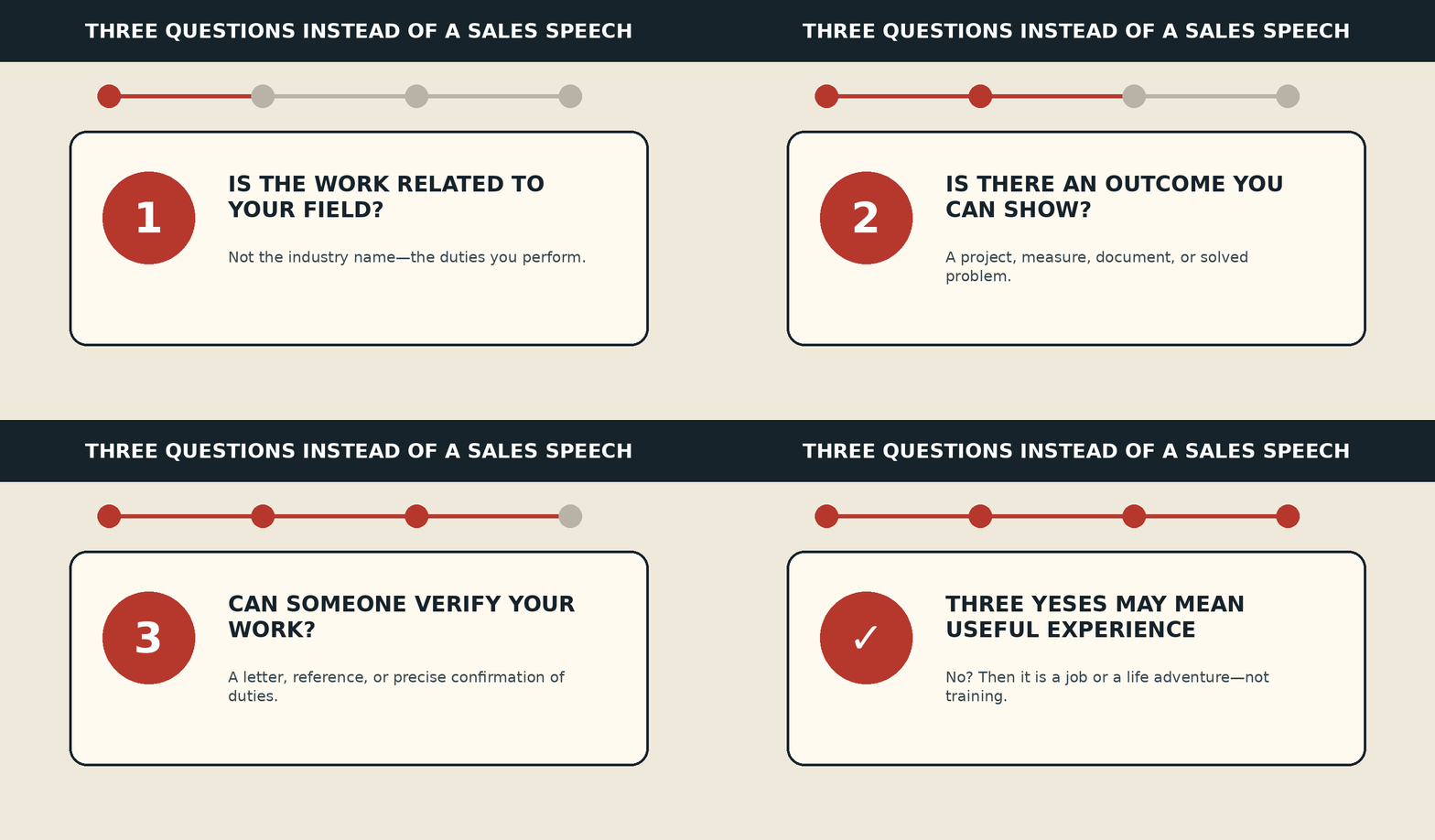
If there is no clear answer, geography will not rescue the résumé.
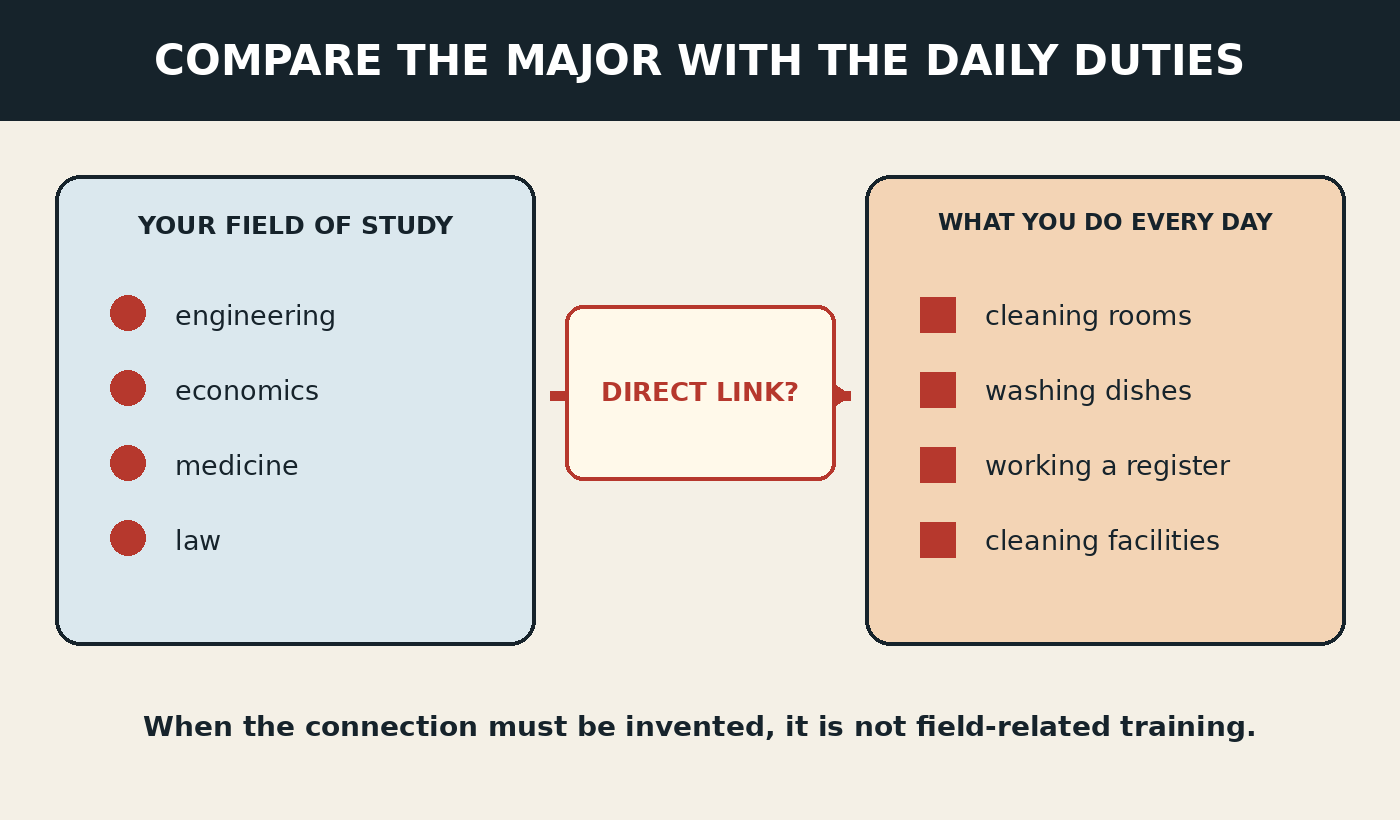
The site’s original Career Myth suggests a brutally simple test: compare your university major with the title and duties in the job offer. An engineering, economics, medical, or law student does not become stronger in that profession merely by changing hotel towels in the United States.
An American address is not a job responsibility
At an agency presentation, everything is packed into shiny phrases: “international company,” “overseas experience,” “a strong résumé line,” and “new opportunities.”
Nice words. But the country name answers none of the questions that matter:
- What will you actually do every day?
- Is the work related to your field of study?
- Will you perform anything more complex than the same task over and over?
- Will a supervisor be able to evaluate a professional result?
- Will you have a project, measurable outcome, document, or reference to show afterward?
When the answer to every question is “but it is America,” the substance has ended. Only the label remains.

Measure the distance between the degree and the duty
Take a sheet of paper. On the left, write your major. On the right, write the exact job title and daily duties. Not the agency’s description. Not “meeting new people.” Write what the employer will actually pay you to do.
Now draw a line between the two columns.
If the link can be explained in one sentence—for example, a hospitality student working at a front desk and learning to resolve guest problems—there may be career value. If the explanation requires a speech about independence, broad horizons, and an “international environment,” the professional connection is weak or nonexistent.
The original article makes another crucial point: the program’s typical positions are basic seasonal jobs, not skilled professional work. Any promise of “training in your field” should therefore be proven by written duties, not by the salesperson’s confidence.
Twelve weeks of “career growth,” counted honestly
The old article’s sarcasm works because it is backed by simple arithmetic.
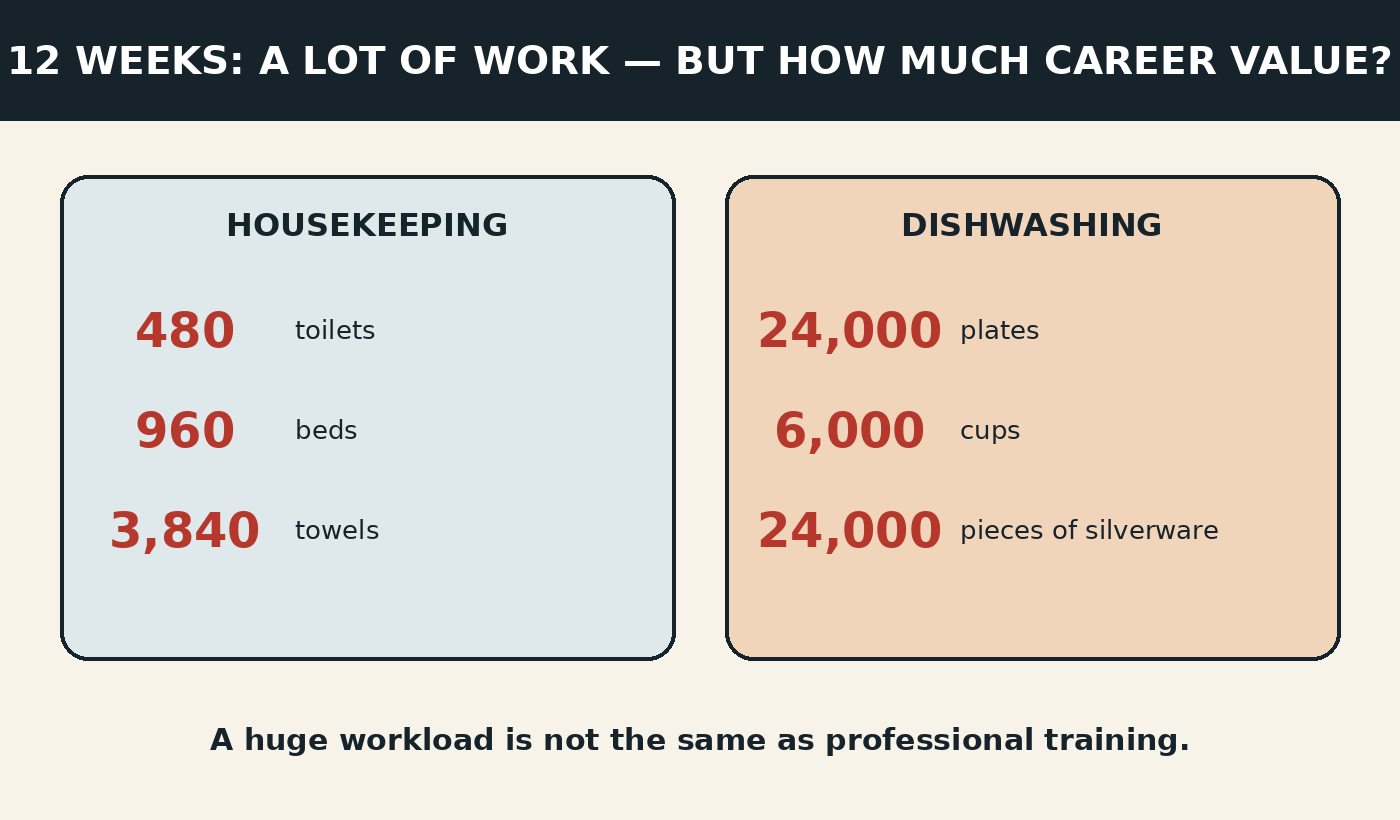
If a housekeeper cleans eight rooms a day, five days a week, for twelve weeks, the summer adds up to 480 toilets, 960 beds, and 3,840 towels. Using the article’s dishwasher example, the season becomes 24,000 plates, 6,000 cups, and 24,000 pieces of silverware.
Those numbers do not insult the work. They remove the packaging. This is demanding, repetitive labor—not a secret staircase to management.
There is another uncomfortable calculation. What could those same twelve weeks produce if invested in a field-related internship, a university project, research, part-time work in a relevant organization, or a portfolio? The site cannot give one answer for every major, and neither can an agent. But students should calculate the opportunity cost before paying, not after returning home.
But surely the trip teaches you something
Of course it does. Living far from home, arriving for early shifts, budgeting, dealing with roommates, navigating an unfamiliar place, and working while tired are real experiences.
Life experience and professional experience, however, are not the same thing.
The confusion is useful to the seller. Ordinary human gains—independence, stamina, courage—are renamed “career acceleration.” A summer job then looks like an investment in a profession even when it has no connection to the student’s field.
The same pattern appears in promises of automatic language improvement. The site’s English Myth explains why tiring work, a narrow vocabulary, and living among other foreign students do not guarantee the result advertised before payment. Claims about cultural exchange should also be read beside the site’s Cultural Exchange Myth.

Four signs that experience can actually help a career
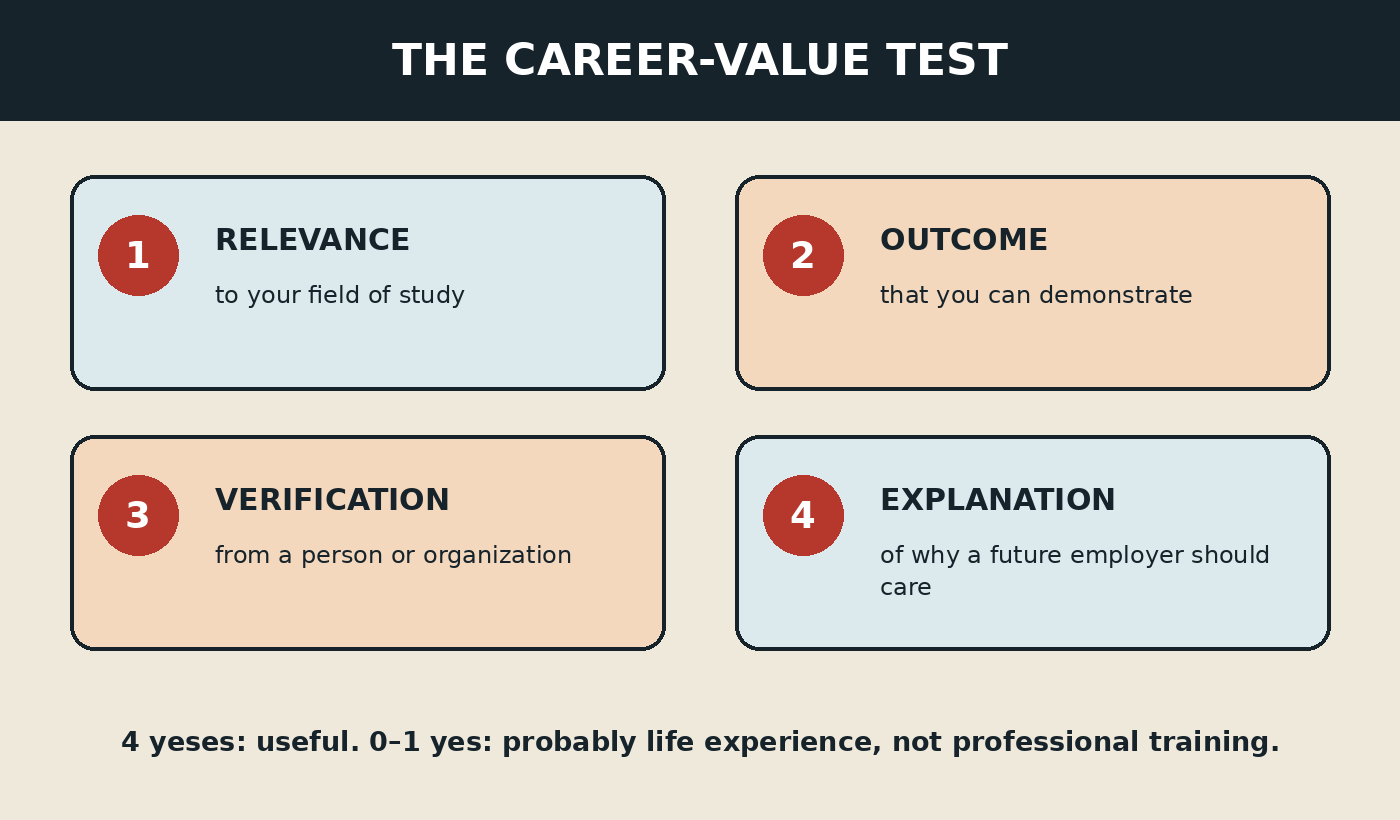
Instead of arguing over labels, test the job against four points.
- Relevance. You apply knowledge from your studies or learn duties used in the profession you plan to enter.
- Outcome. The work leaves more than a memory: a completed project, improved measure, prepared document, solved problem, or demonstrable result.
- Verification. A person or organization can confirm what you did and how well you did it.
- Explanation. In thirty seconds, you can tell a future employer what you learned and why it matters to that employer’s role.
Four yeses are encouraging. Two are questionable. Zero or one usually means you have a life experience and perhaps a way to earn money—not professional training.
Open the five-minute career-value test
- Write five daily duties without promotional language.
- Beside each duty, name the field-specific knowledge it develops.
- Write the result you will be able to show or measure.
- Name the person who can verify your work.
- Write one honest sentence for a future employer.
When steps 2–4 remain blank, do not call the trip a career investment. Call it what it is.
How to describe the trip honestly on a résumé
You do not need to hide the trip. You also do not need to inflate it into an “international internship.”
A weak description says: “Gained invaluable experience in an international company and developed leadership skills.”
A sensible interviewer will ask: What did you lead? What changed because of your work? How many people reported to you? The advertising balloon then bursts in the interview room.
An honest description is built from facts:
| Fact | What it may demonstrate | Evidence |
|---|---|---|
| Twelve weeks of seasonal hotel work | Stamina, punctuality, work under time pressure | Contract, employer letter, exact duty description |
| Direct contact with guests or customers | Calm handling of routine service problems | A concrete situation and outcome |
| Independent life in another country | Organization and responsibility | A brief truthful explanation, not grand claims |
There is no invented “professional internship” in that table. There are facts, reasonable conclusions, and boundaries. The description is less glamorous, but it survives follow-up questions.
When a summer job may genuinely support a profession
Exceptions exist. The original Career Myth explicitly notes that some roles may be useful to students studying hospitality or restaurant management. The key word is some.
A front-desk role, structured kitchen training, or a position that genuinely involves resolving guest problems may provide relevant material. Cleaning rooms does not automatically become hotel-management training. Washing dishes does not become restaurant-management education merely because the kitchen is in the United States.
Do not confuse the industry with the duty. You can clean floors in a major hospital without receiving medical training. You can deliver mail inside a famous bank without learning financial analysis. You can change linens for a global hotel chain without learning hotel management.
Eight questions to ask the agent before paying
Ask in writing and request written answers. A promise that disappears when you ask to put it on paper has already answered your question.
- What is the exact job title without promotional language?
- Which five duties will occupy most of my time?
- Which of those duties directly relate to my major?
- Is there structured training, who provides it, and how long does it last?
- What result will I be able to show a future employer?
- Who will provide written confirmation of my duties and performance?
- Can I speak with last year’s participant in this exact role?
- What happens if the duties are different after arrival?
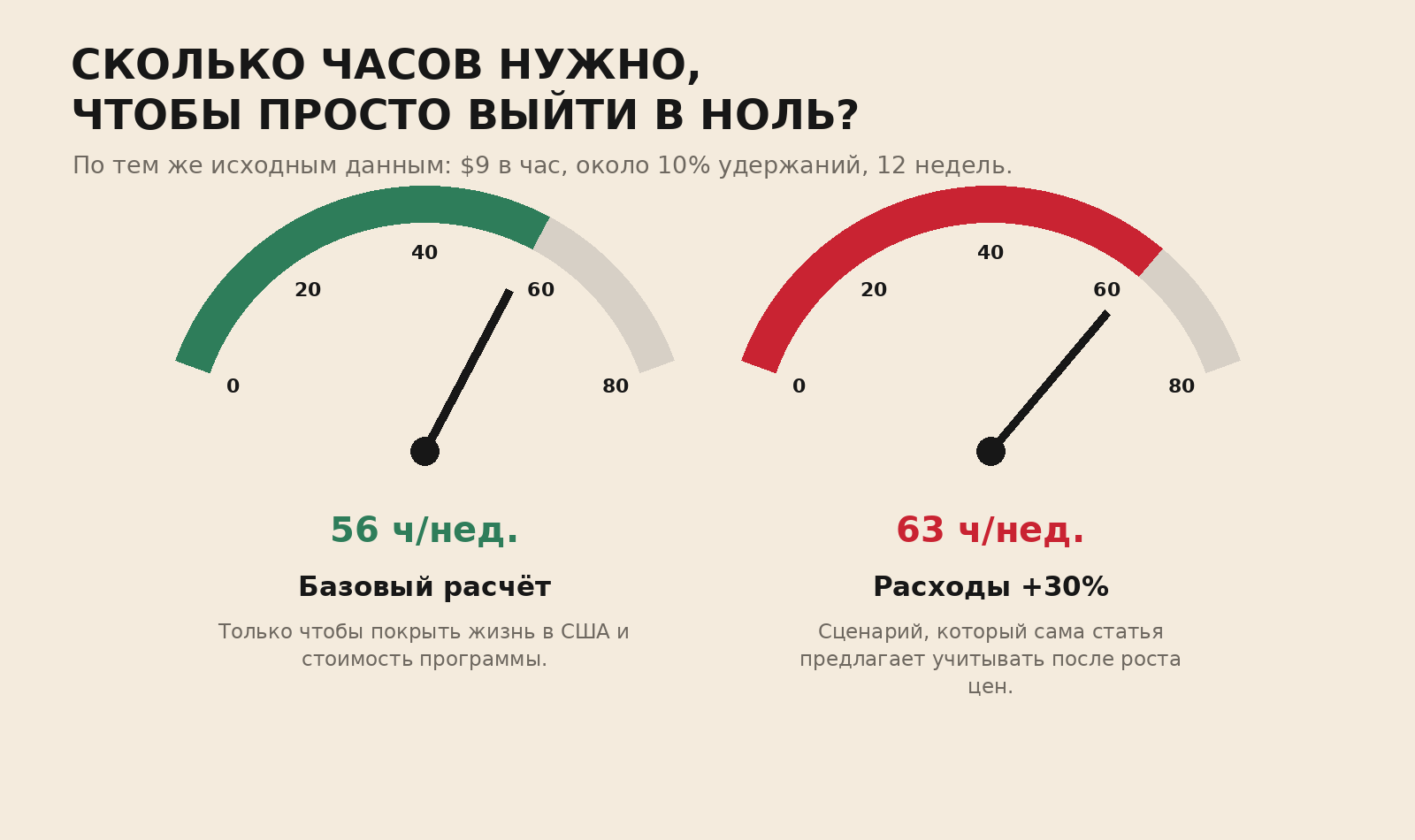
Calculate the entire cost as well. The site separately examines what the program can cost. When a family pays thousands of dollars for a promised career advantage, it has every right to demand a clear connection between the expense, the duties, and the student’s future profession.
For parents: do not buy a decorative résumé line
Parents are especially vulnerable to words such as “independence,” “international experience,” and “future.” Everyone wants a son or daughter to mature, see the world, and gain an advantage.
That advantage does not come from a passport stamp. It comes from knowledge, work, and a result that can be demonstrated.
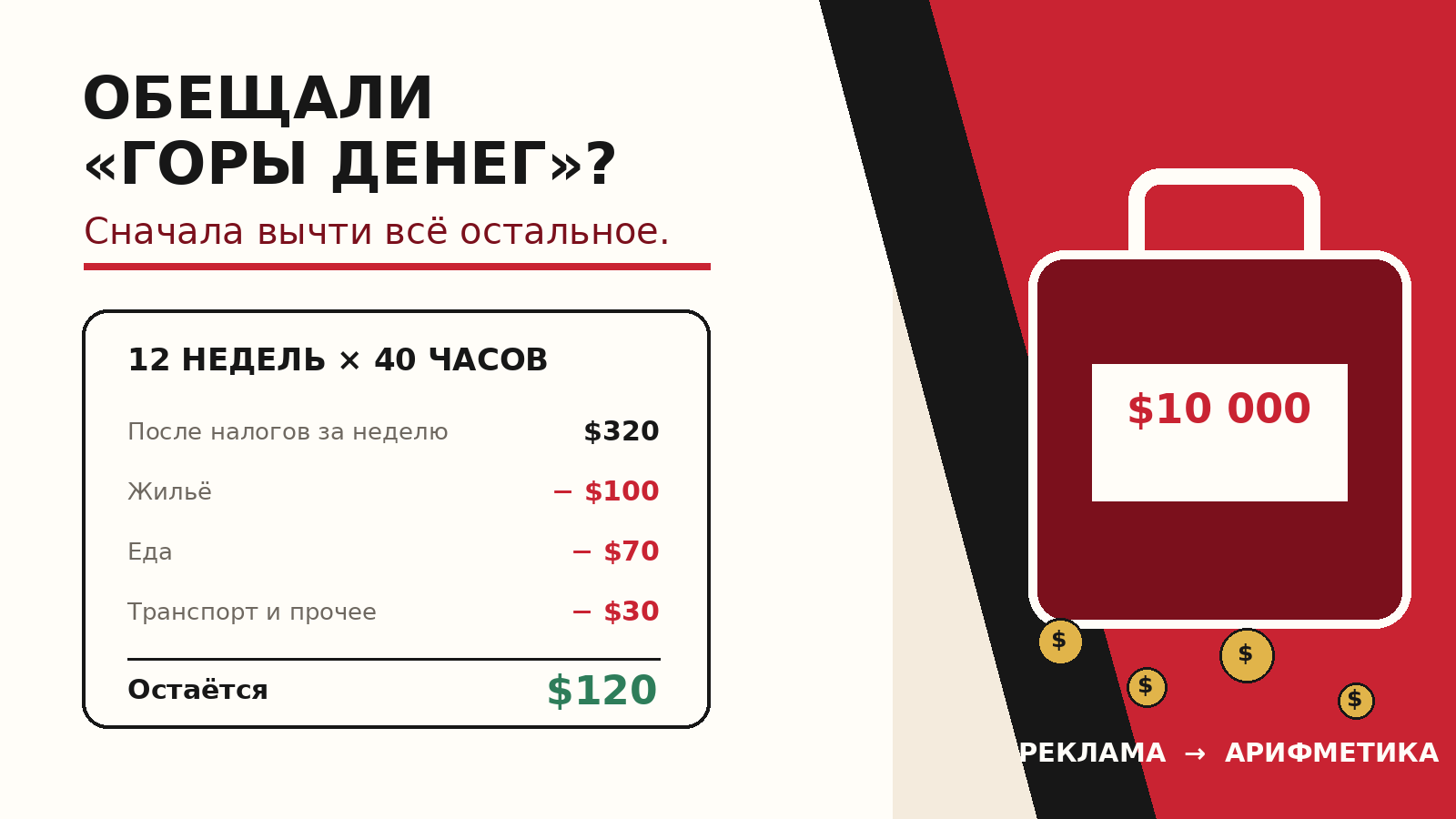
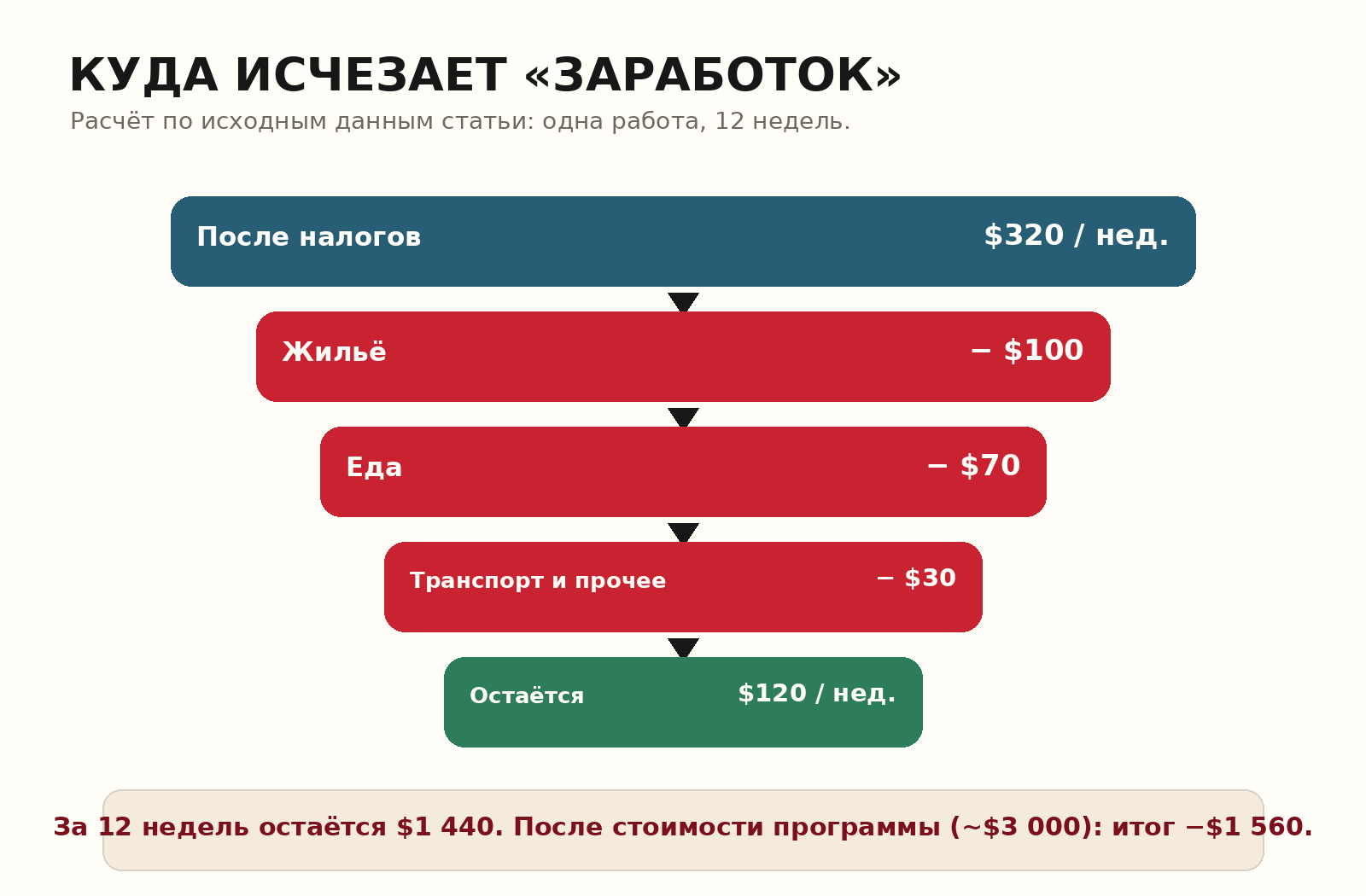
When the trip is for adventure, say so. When it is for earnings, read the site’s money calculation. When it is for English, read the language myth. When it is for career development, demand exact duties and compare them with the major.
The most expensive mistake is to pay for one thing, receive another, and then comfort yourself with “at least it was experience.” It will certainly be an experience. The real question is what kind—and whether it was worth the summer.
The conclusion, without presentation music
A summer job in the United States may make a person more independent. It may produce stories, friends, exhaustion, disappointment, confidence, a few useful habits, and—under favorable conditions—money.
But a career does not appear because someone used the word “international.” Career value appears when the work is relevant, produces an outcome, can be verified, and survives a future employer’s questions.
Before paying, do not ask, “Will America look impressive on my résumé?”
Ask the harder question: “What will I be able to do better when I return, and how will I prove it?”
Here are 25 more useful articles and excerpts from the site’s book, in the same order as the home-page collection:
- The money and earnings myth
- The English-practice myth
- The career and international-experience myth
- The tax-refund myth
- The medical-insurance myth
- The cultural-exchange myth
- The J-1 visa interview and more than 100 commonly asked questions
- Why students bring buckwheat to America
- Sex. Money. Work and Travel USA. Part One
- Sex. Money. Work and Travel USA. Part Two
- “Niga, do you have a dolar?”
- What does the press say?
- Murders and sexual assaults involving Work and Travel USA participants
- Greedy Yankees: how American companies profit from Work and Travel participants
- “Deceived by America”: how the State Department, sponsors, and agents profited during the pandemic
- Russian WaT Roulette: an overview of Work and Travel USA
- The main participant categories: what may await you in America?
- Real reviews from Work and Travel USA participants
- The Work and Travel USA class-action lawsuit
- How much does Work and Travel USA cost?
- How much do foreign agents and sponsors make?
- The WaT setup that sent students to an American prison for 30 years
- DarkNet WaT: how agents trade students’ personal data
- “Humiliating and silly”: why Western Europeans do not join Work and Travel USA
- J-1 Internship: another scam or something worthwhile?