
“If I’d known about these new checks, I’d have cleaned up my pages in advance instead of panicking at the window. They sent me off to ‘wait’ — and summer left without me.”
— Dinara, WaT participant, 2026
Hey everyone. We keep taking the Work & Travel USA program apart piece by piece — Russian WaT Roulette. Today: a fresh twist this season that agents somehow forget to mention at their meetings. The consulate now reads your social media before deciding whether you get a visa. Ready? Let’s dig in.
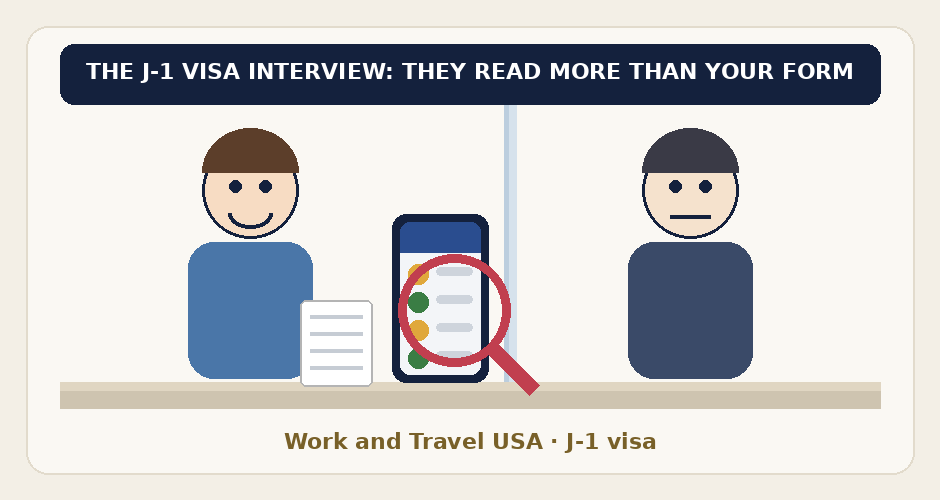
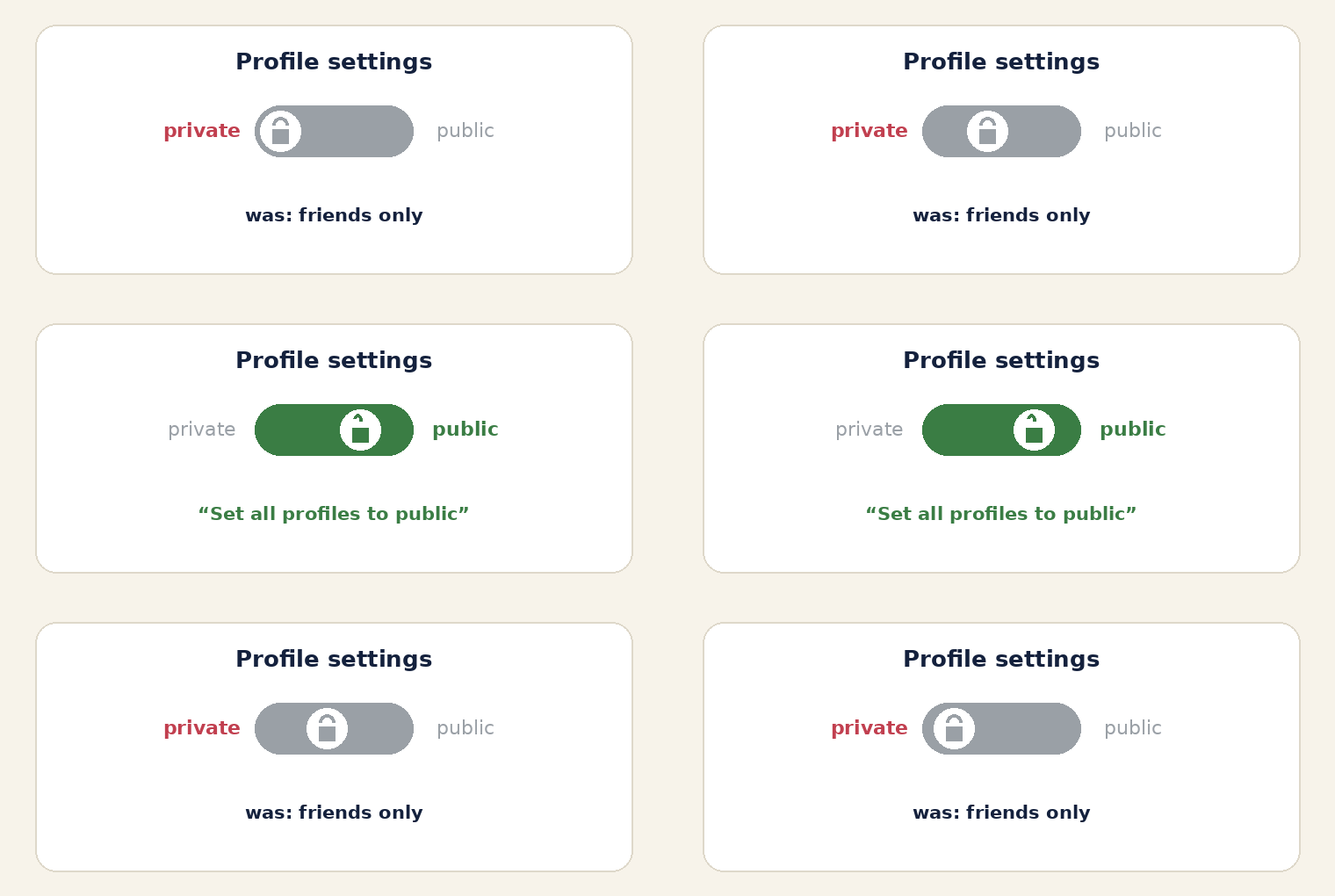
You passed the selection, handed your agent around $3,000, packed your suitcase and memorised how to say “room cleaning” in English. You show up for your visa interview — and the consul asks you to make all your profiles public, then quietly goes off to read them. Along with everything you’ve posted, tagged and shared over the past five years.
So what actually happened
On 18 June 2025 the US State Department sent every embassy and consulate a cable with a mouthful of a title — “Expanding Screening and Vetting for FMJ Applicants.” Category J is exactly your J-1 visa for Work & Travel USA. In plain English: your online life now gets read before the visa is issued, not after.
And just before that, in late May, interviews for student and exchange visas were paused worldwide while consulates waited for new instructions. In June the windows reopened — under new rules.
- set every one of your social media profiles to public;
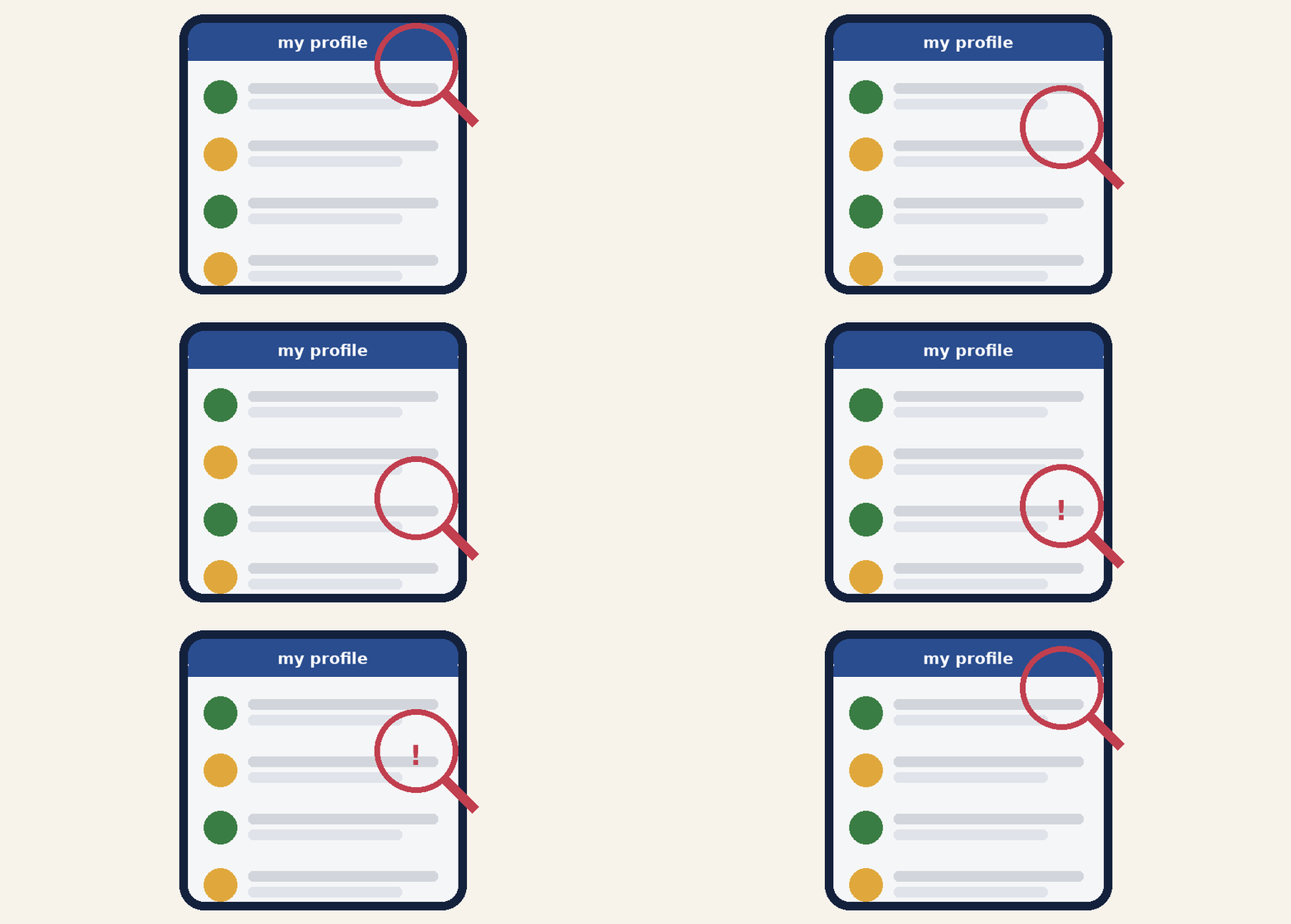
- the same consular officer who interviewed you personally combs your entire online footprint — not just social media, but whatever search returns on your name;
- even if your paperwork is fine, the case is first formally refused under section 221(g) so they can take their time checking;
- no speed quotas: staff are told to spend “as much time as necessary.”
How the screws kept tightening
This wasn’t a one-off — it’s a chain. Open each step and you’ll see the list of checks only grows.
“Your whole online footprint” isn’t just your latest stories
Making “all your pages” public isn’t about one Instagram. On the DS-160 form you’re required to list every social media handle you’ve used over the past five years. Even the ones you haven’t touched since your first year of uni. Even the ones you “deleted long ago” — because cached copies and other people’s screenshots outlive your memory.
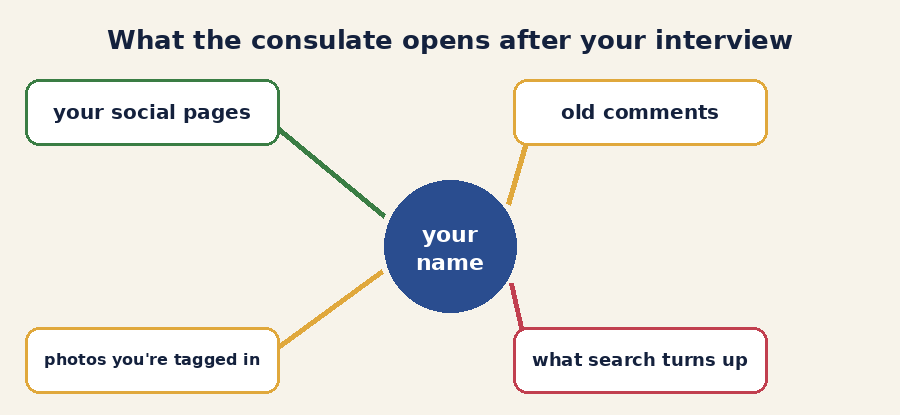
“Footprint” here means literally everything:
- old VK and Odnoklassniki pages;
- that abandoned Twitter and dead Telegram channel;
- comments under other people’s posts and in groups;
- photos other people tagged you in;
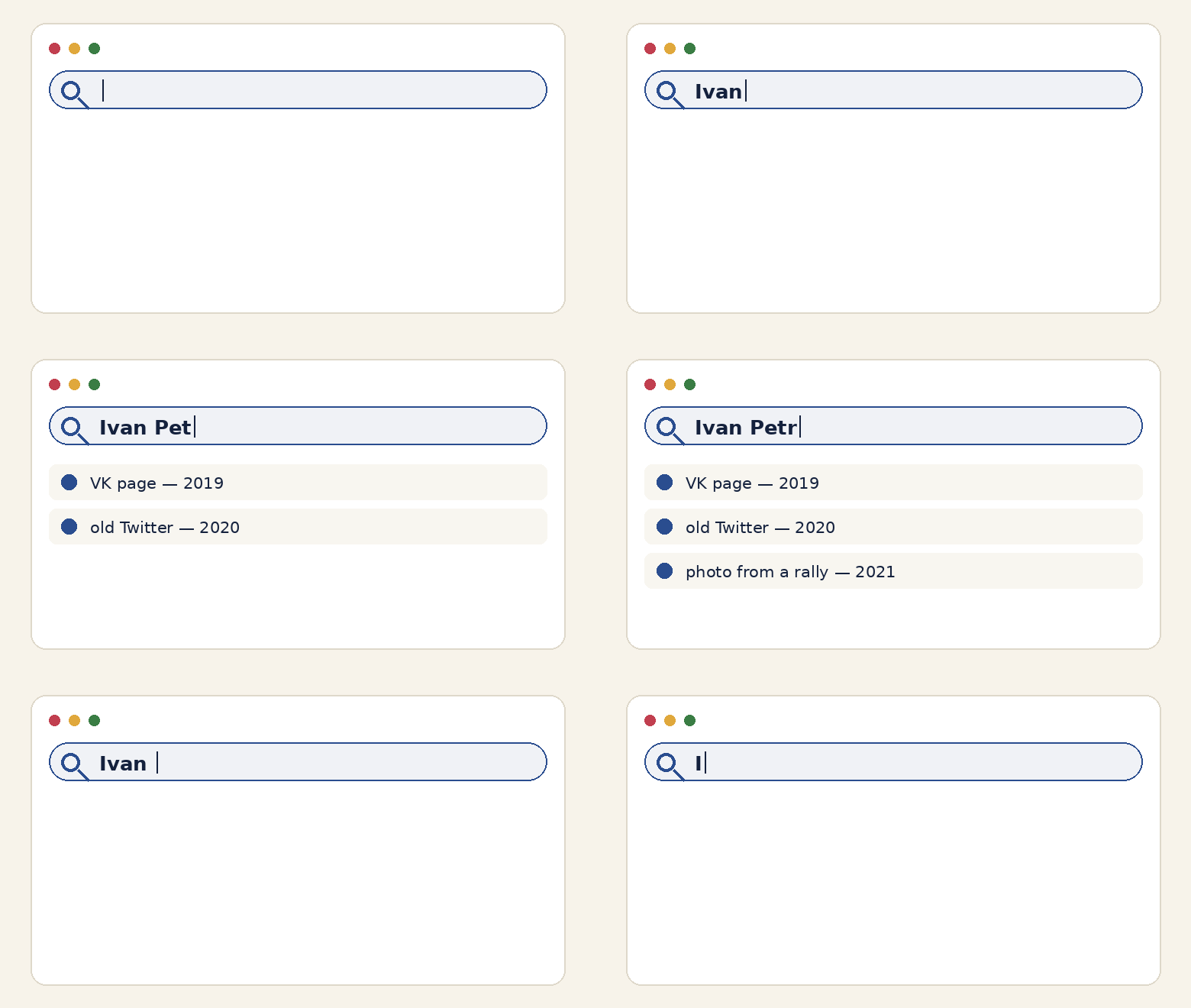
- anything a search engine returns for your first and last name.
The irony? Your personal data has been floating around for years — agents leak it by the bundle. Now the consulate joins the list. Except it reads openly, with the power to say no.
Why the interview got scarier — and the line longer
Consuls used to be done in a couple of minutes: two questions, a stamp, next. Now there are no speed quotas — they’re specifically told not to rush. Sounds humane; in practice it means one thing: the line stalls, timelines slip, and your outcome hinges on what the person behind the glass finds under your name and how they read it.
Here’s the slippery part. The official goal is to spot “hostility toward US citizens, culture, government, institutions or founding principles.” What counts as “hostility” is nowhere clearly defined. An old joke about America, a sharp comment under some news, someone else’s opinion you once shared — all of it now gets read by a live human with the power to refuse. And there’s simply no transparent list of what’s fine and what isn’t.
A former consular officer turned immigration lawyer put it bluntly: the new procedure is so cumbersome that it slows visa issuance far more than it catches anyone genuinely dangerous. Same old pattern: just like during the pandemic, it’s the student who’s left holding the bag.
What your agent won’t tell you
Your agent will keep insisting “everyone who pays gets a visa” and that the interview is a mere formality. It suits them: their income is your contract, not your visa. That the consul now reads your social media and can refuse you without explanation? Rarely comes up at the meeting. And it definitely won’t be mentioned that you pay for the program before the interview, not after.
Remember what this whole chain exists for. Work & Travel USA is big business, and the agents’ main job is to make millions off you. While you dream about summer in the States, people are already earning on you: the one who sold the program, the one who filed the papers, the one who’ll “help” you claim your tax back. The new social media check changes none of that math for them — the one taking the risk is still you.
What that 221(g) they scare you with actually is
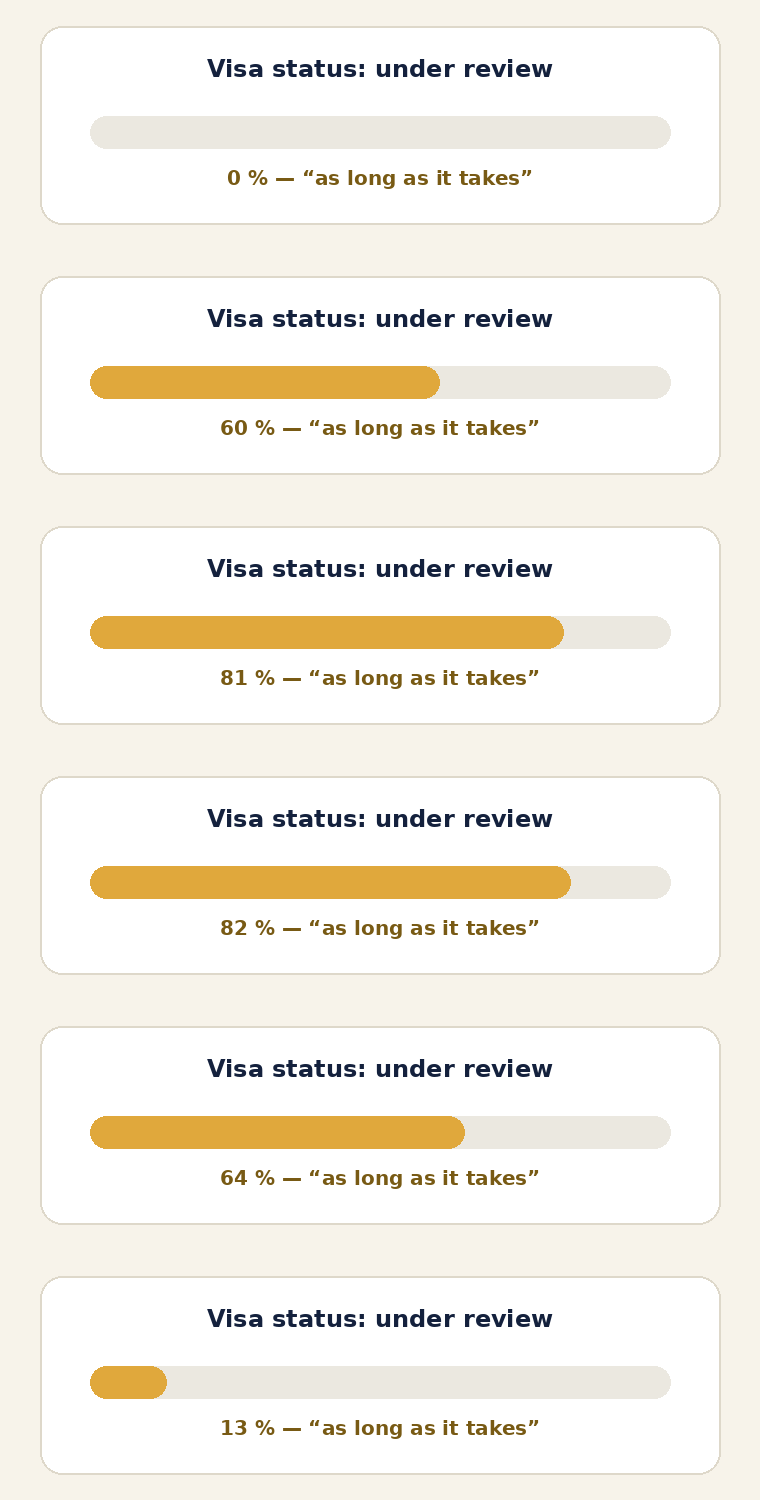
The most confusing moment for a student is when they take your passport at the window and hand you a slip with the number 221(g). Plenty of people decide right there that they’ve been refused for good and call their parents in tears. In reality it’s not a final refusal — it’s a pause: the case is set aside so they can check you at leisure. The visa might come in a week, in a month, or not at all.
The problem isn’t the pause itself — it’s that it has no deadline. The program won’t wait: the employer gives your spot to someone else, the tickets burn, and summer ends on schedule. Your agent has little to say at that point — they have zero influence over the consul’s decision, even if they hinted otherwise before you paid.
What exactly they look for in old posts
There’s no official list of no-nos, and that’s the whole problem. But the cable’s wording makes it clear where attention lands: they’re asked to look for signs of hostility toward the country you’re heading to. In practice, the eye catches on fairly predictable things.
- harsh takes on the US, Americans and their way of life — even if it was a joke among friends;
- pictures and posts about weapons, drugs, anything brushing up against the law;
- hints that you plan to stay in the States — “dreaming of never coming back,” said in jest, does not read as a joke;
- mentions of unauthorised side jobs and chatter about “how to get around the program rules”;
- other people’s posts you once shared without reading closely.
A separate trap is mismatches. If your form says you’re a student going for the summer and returning to study, but your pages show you dropped out a year ago, the questions won’t be about your social media — they’ll be about your honesty. And that’s exactly what gets you refused fast, no discussion. For who actually goes on the program and with what expectations, we’ve got a separate breakdown by participant type.

How much are you risking: a quick self-check
Answer five questions honestly and you’ll see where you’re thin. Tap each one to see how the consulate will read it.
FAQ
In short
Want to improve your English, collect some “international experience” and claim your tax back? Good luck — but before you hand $3,000 to WaT agents, take a sober look at what you’re getting into. Their job is to sell the program and earn off you; your pages and your visa concern them precisely until the contract is signed.
Use your head. Check your pages. And don’t buy a pretty fairy tale off someone else’s slide deck.

More about the WaT program
Knowledge is power. So, to help students and their parents, here are some suuuuper useful articles and other excerpts from our book:
- The WaT myth about money and earnings
- The WaT myth about practising your English
- The WaT myth about careers and international experience
- The WaT myth about tax refunds
- The WaT myth about health insurance
- The WaT myth about cultural exchange
- The J-1 visa interview and 100+ questions you may be asked
- Why do students haul buckwheat to America?
- Sex. Money. Work and Travel USA. Part one
- Sex. Money. Work and Travel USA. Part two
- “Hey, you got a dollar?”
- What does the press say?
- Murders and rapes of Work and Travel USA participants
- Greedy Yankees: how US companies cash in on WaT participants
- “Betrayed by America”: how the State Dept and agents profited during the pandemic
- Russian WaT roulette: a review of the Work and Travel USA program
- The main types of participants, or what awaits me in America?
- Real reviews from Work and Travel USA participants
- The Work and Travel USA class-action lawsuit
- How much does the Work and Travel USA program cost?
- How much do foreign agents and US sponsors of Work and Travel USA earn?
- The WaT setup: how students got 30 years in a US prison
- The dark side of WaT: how agents sell students’ personal data
- “Embarrassing and silly”: why Western Europeans skip Work and Travel USA
- The J-1 Internship/Trainee program: another scam or the real deal?

 comingtoamerika.com