
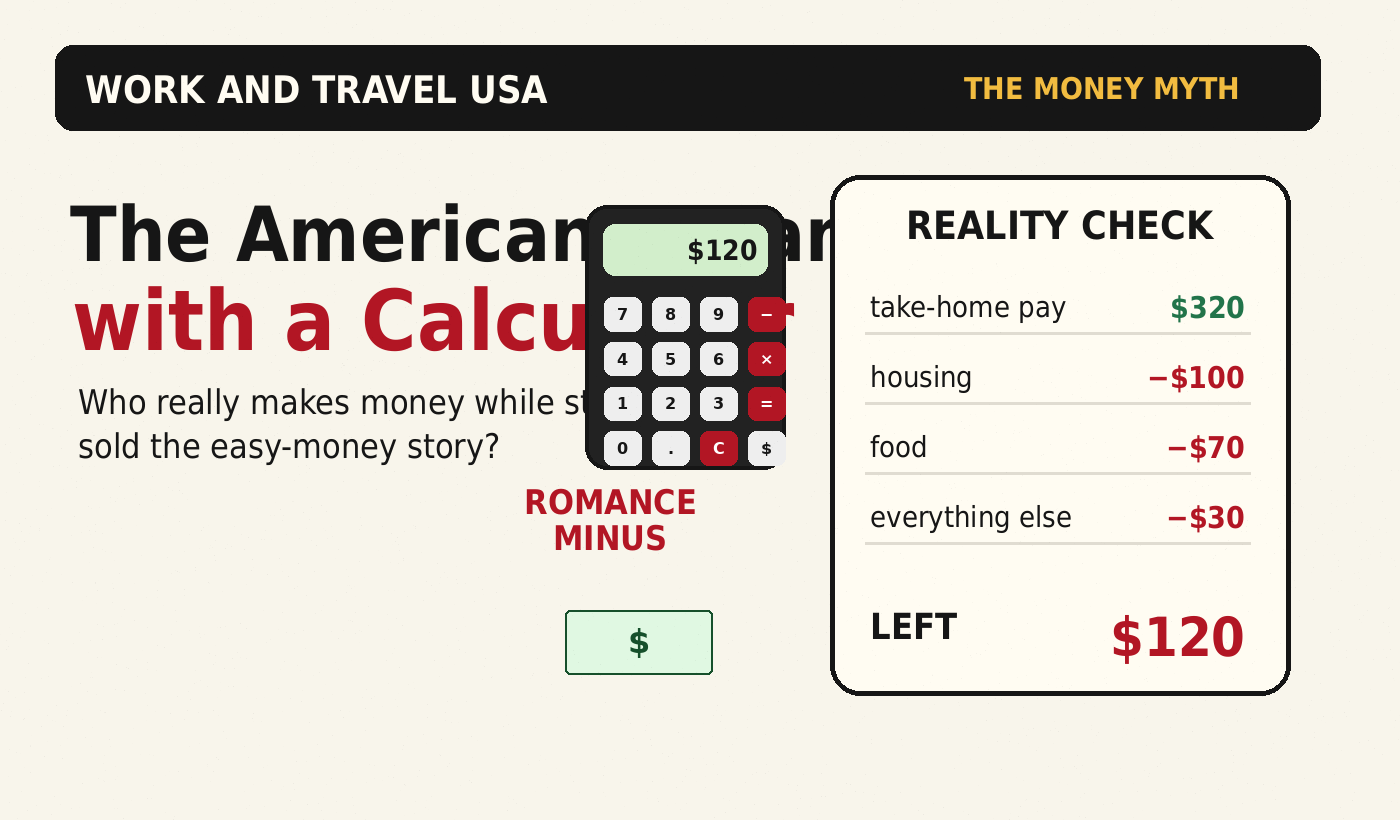
“Go to America, make money, pay back the trip, and come home with a new iPhone.”
Sound familiar? Of course it does. Recruiters have been singing that song to students and parents for years. Sometimes it comes with a smile. Sometimes with a polished presentation full of skylines, beaches and happy faces. You can almost hear the dollars dropping straight into the suitcase.
There is only one small problem.
Dollars do not fall into suitcases.
The closer you get to the real arithmetic of Work and Travel USA, the faster the glossy sales picture turns into an ordinary expense sheet. On one side: “the dream.” On the other: rent, taxes, food, transport, fees, deposits, a phone plan, work clothes, the ride to work, the ride back, and a tax refund that may come with another bill attached. Before calculating any future earnings, it is worth checking what the program actually costs from start to finish.
Yes, the same calculator recruiters rarely seem eager to open during the presentation.
Myth: “Just get to America and the money will follow”
This is where the main trick begins. The student is not really being sold a job. The student is being sold the feeling that America is a giant cash machine waiting for one more lucky visitor.
You land, smile, say “How are you?”, and suddenly the employer gives you 40 hours. Then another employer gives you 20 more. Then come the tips, the tax refund, the coast-to-coast trip and a suitcase full of gifts for everyone back home.
Sounds good?
Of course it does.
In reality, Work and Travel is not a magic money elevator. It is seasonal, low-paid work, usually in simple and physically tiring jobs: housekeeping, kitchens, cleaning, fast food, amusement parks, hotels, warehouses, cash registers, dishwashing, carrying boxes and turning over rooms. There is very little glamour in it. There is a normal work shift, tired feet and one evening question: “Where are the thousands I was promised?” Anyone being sold “international experience” and a career boost should also read what the career promise usually looks like in practice.
The simple arithmetic that ruins the mood
Let us use a normal scenario, not a fairy tale.
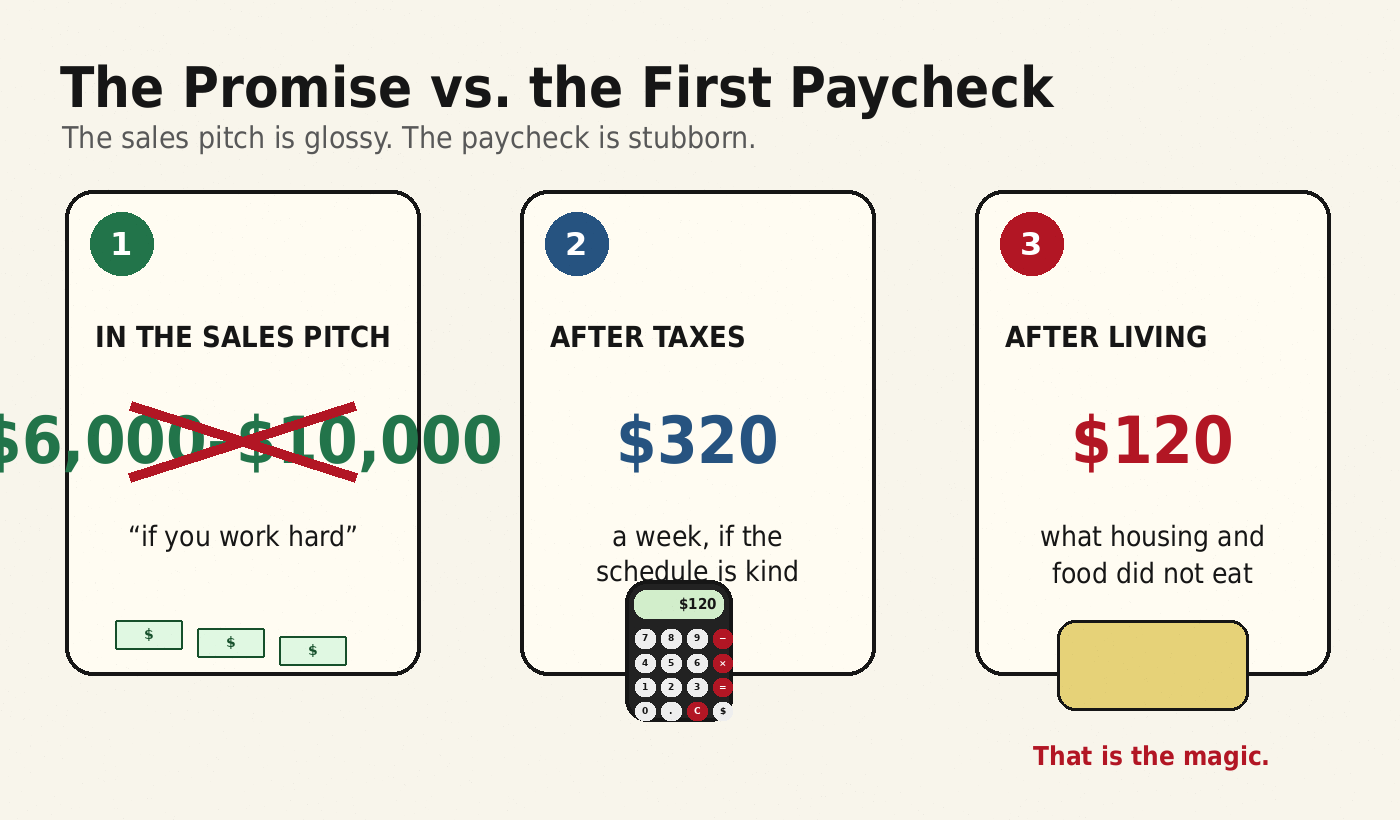
Suppose you have one job. Suppose you get 40 hours a week. Suppose the wage is around $9 an hour. That does not sound terrible. Then taxes arrive, and the real take-home number looks less attractive. Then you pay for housing. Then food. Then transport. Then all the “little extras” that usually live somewhere outside the recruiter’s presentation.
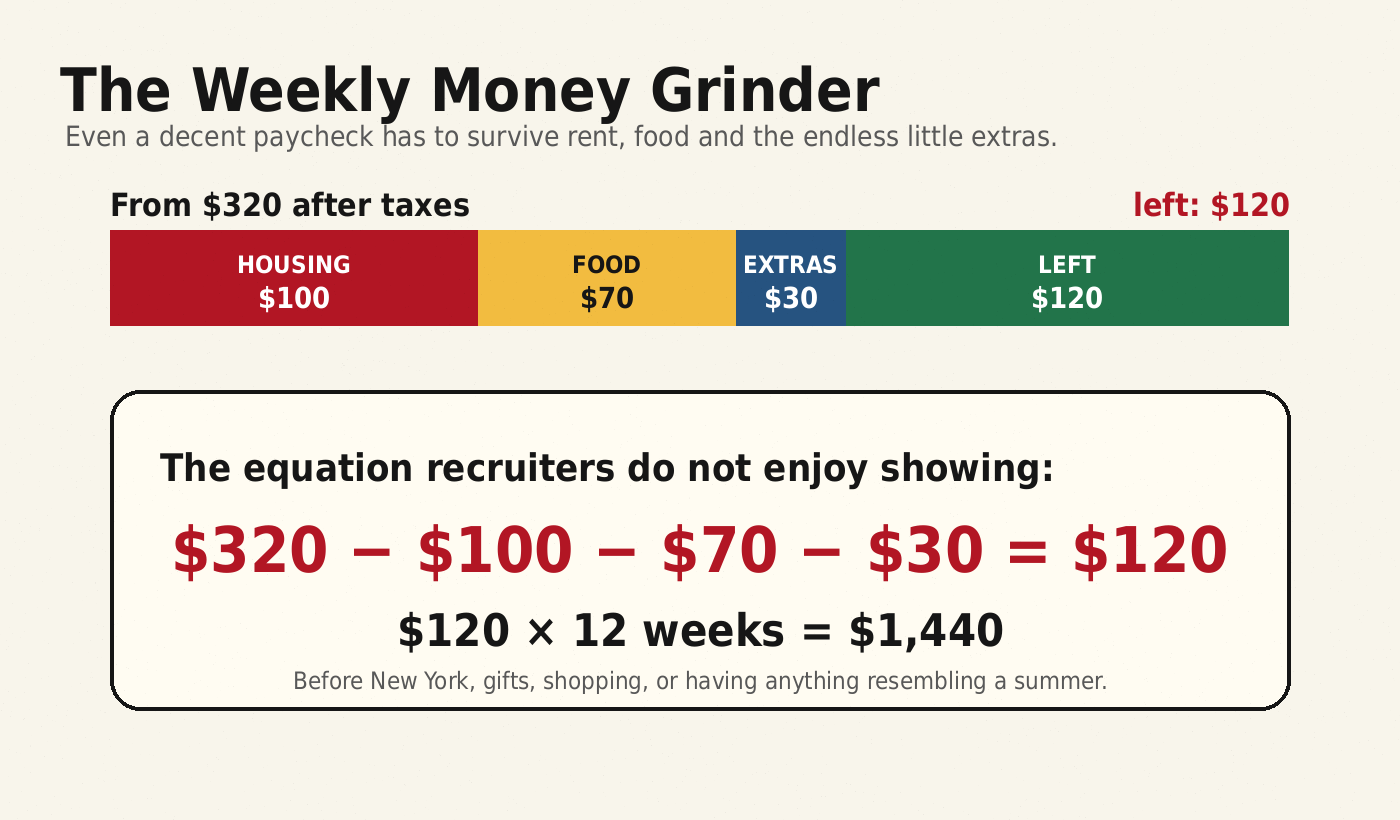
A sample week might look like this:
| Item | Amount | Comment |
|---|---|---|
| Income after taxes | $320 | if you were lucky enough to get 40 hours |
| Housing | − $100 | and that is still fairly modest |
| Food | − $70 | assuming you do not live like a millionaire |
| Other expenses | − $30 | uniform, transport, phone and “small” expenses |
| Left for the week | $120 | there are your “mountains of money” |
Now multiply that by 12 weeks.
$120 × 12 = $1,440
This is usually the point where the student develops the facial expression that never makes it onto the agency brochure.
Before the trip, the line was “you will pay it back in the first month.” After the arithmetic, the entire summer may not even cover the full cost of participation. And we have not yet included perfectly normal human plans: visiting New York, buying gifts, going out, enjoying the country or eating something other than the cheapest food available.
“I will just get a second job” — the favorite prayer
Yes, a second job can help. Sometimes it is the only thing that pulls the trip out of the red. But it is worth removing the rose-colored glasses.
A second job is not a button marked “add money.” It means searching, approvals, schedules, transport, exhaustion, clashing shifts, the risk of losing hours at the first job and constant running between employers. Instead of traveling around America, you may spend the summer washing one uniform at midnight while calculating how many hours of sleep remain before the next shift.
The program is called Work and Travel. But when earning money becomes the priority, it often turns into Work and Work. Travel can happen later, if any money, time and energy remain.
So who really makes money?
Now for the uncomfortable question.
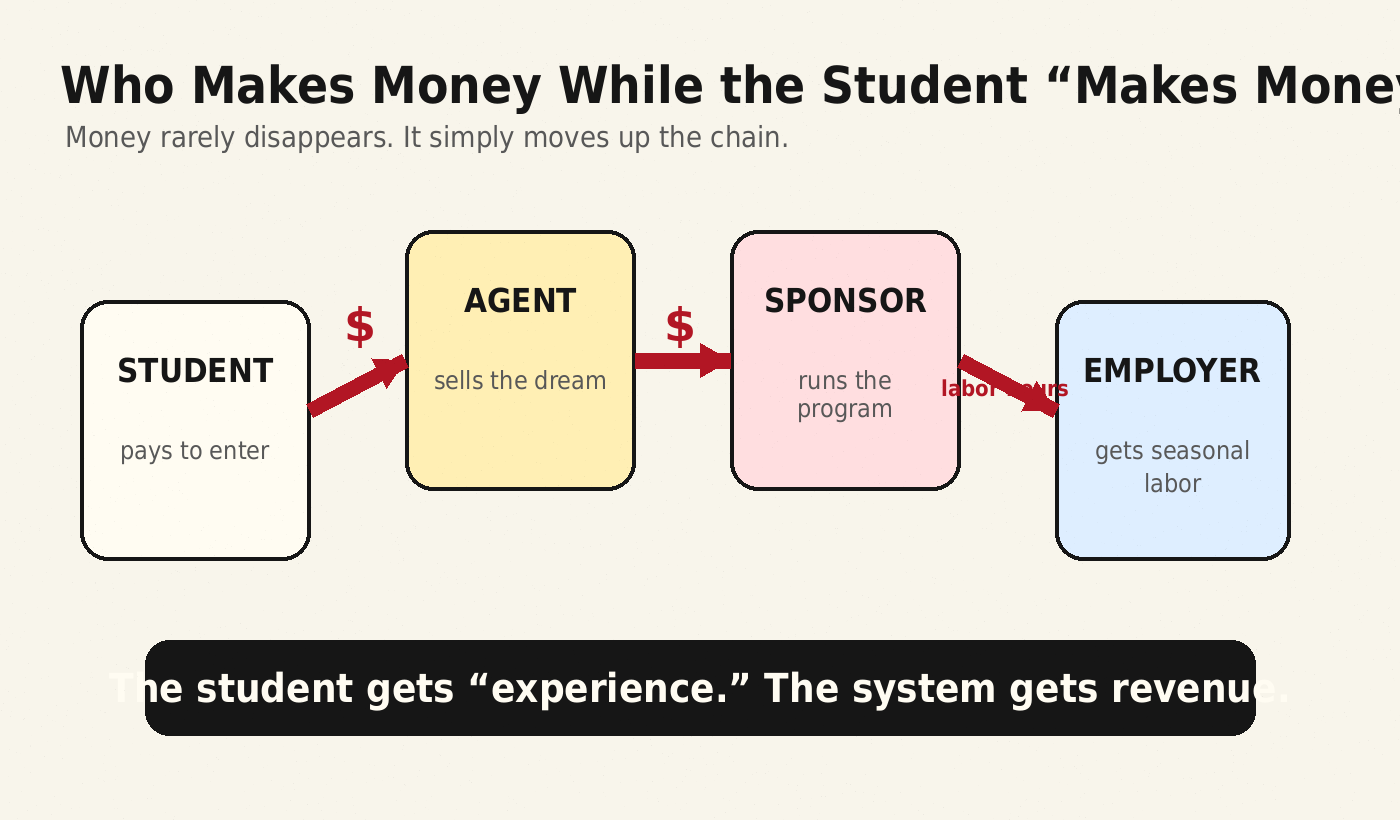
If the student often fails to recover the cost, if the parents do not get their money back, and if the promised thousands shrink after rent and food, who is actually making money?
The answer is simple: the system. The site also breaks down how much foreign agents and American sponsors make from the program.
Agents are paid for recruitment. Sponsors are paid for administering the program. Employers receive seasonal labor. Other intermediaries collect commissions, fees, surcharges and payment for “services.” Even the tax refund can become another opportunity to sell the student hope for a fee.
Elegant, is it not?
First, the student pays to gain access to a low-paid job. Then the student works to recover the money already paid. Then the student may pay again for help recovering part of the money withheld from the paycheck. Finally, somebody explains: “At least you gained experience.”
The student certainly gained experience. The more useful question is: who gained the money?
The main product is not a job. It is hope.
One point matters more than the others: the agent is not selling only a program. The agent is selling the hope of a quick jump forward in life.
The student wants America. The parents want their child to see the world, improve English, become independent and earn some money. These are normal wishes. They also make excellent sales material.
The presentation rarely says: “You may count every dollar, share crowded housing, fight for hours and spend the summer trying not to lose money.”
Instead, the student hears:
- “It is the opportunity of a lifetime.”
- “Everyone comes home happy.”
- “You can make very good money.”
- “You will get the taxes back later.”
- “Finding a second job is easy.”
- “America is full of opportunity.”
This is an ordinary sales process aimed at someone who may be signing a serious contract for the first time, borrowing a large amount from parents for the first time, and learning for the first time that attractive promises must be checked with numbers rather than emotion. The same applies to promises about language practice: compare them with the site’s English myth, and compare the “cultural exchange” pitch with the cultural exchange myth.
Taxes: “You will get them back later.” Sure.
The tax refund deserves its own song.
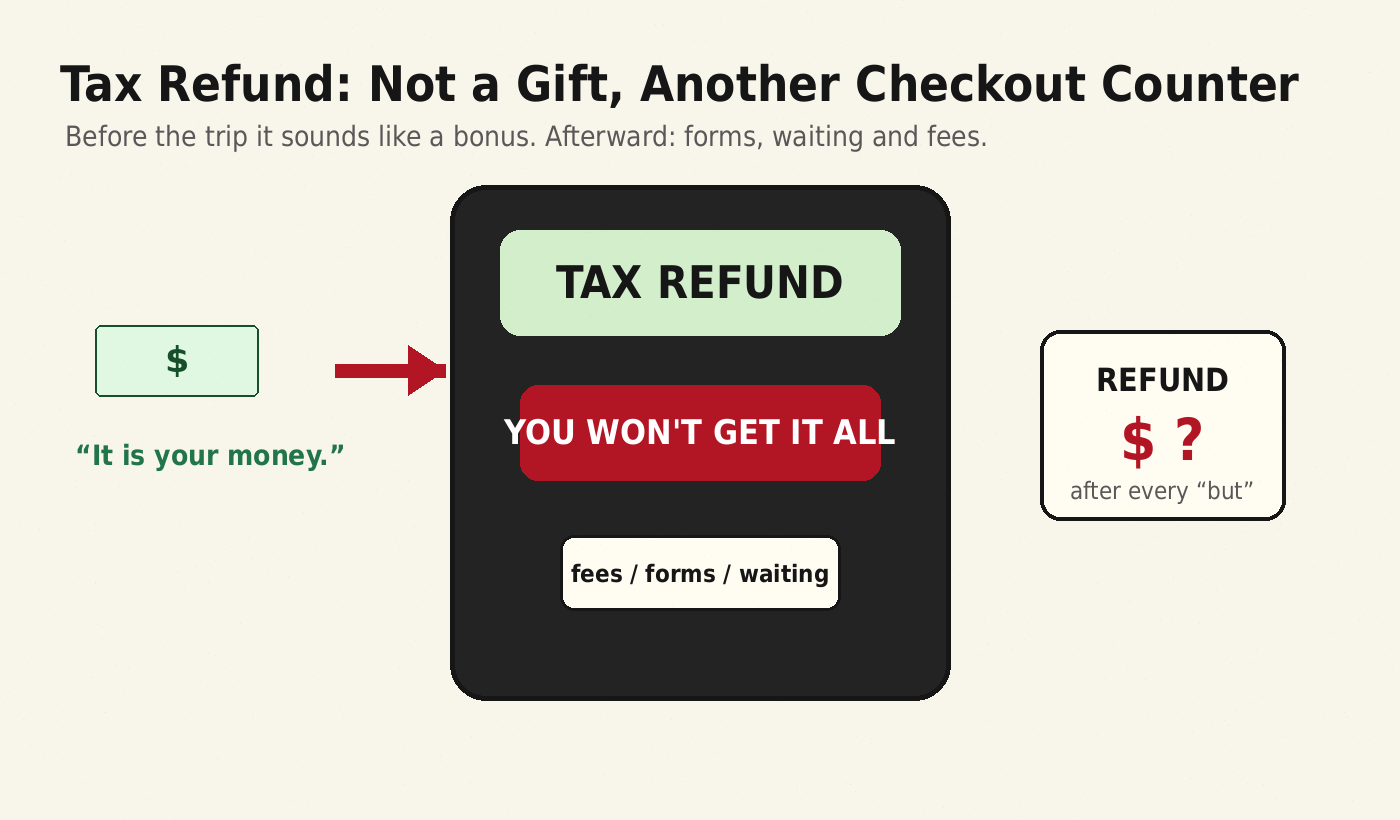
Before departure it is often described almost as a bonus: “Do not worry, you will get the taxes back.” The student hears this and thinks: fine, they will take it now, but it will return later as a useful reserve.
Then comes the discovery that federal tax is not a personal savings account. Not everything necessarily comes back. Filing may cost money. The paperwork takes time. The process is less simple, less quick and less cheerful than it sounded before the program fee was paid.
In the sales pitch, the tax refund looks like a future gift. In real life, it can become one more checkout counter where the student pays again. Before departure, read the detailed tax-refund myth and the separate explanation of the medical-insurance myth.
“But some students really do bring money home”
Yes, some do. Nobody is claiming that earning money is impossible.
Some students find a good location, receive plenty of hours, secure a second job quickly, live very cheaply, spend almost nothing, avoid illness, avoid bad housing, avoid employer trouble, keep every shift and work through the summer like machines.
Those stories exist. They are also the stories that get displayed as proof that the program works exactly as advertised.
Using a rare successful result as the normal result is a familiar sales trick. One student brings home a respectable amount? Put the photograph on the website. Nine students barely recover part of the cost? Silence. One person earns well? “See, anything is possible.” Ten discover that their expectations were inflated? “They simply did not work hard enough.”
Convenient logic.
If you make money, the program is wonderful.
If you do not, it was your fault: you worked too little, spent too much, failed to find another job, smiled incorrectly or did not believe strongly enough in the American Dream.
Do not ask, “What if everything goes perfectly?” Ask, “What happens if everything is merely average?” The site’s participant categories provide another useful way to compare expectations with likely outcomes.
Parents should use the calculator too
Parents often see Work and Travel as a useful school of life. Let the student travel, work, see another country and become more independent. There is nothing wrong with that goal.
The problem begins when the family is sold the trip as an almost guaranteed financial return.
If you are giving your child money for the program, do not automatically treat it as a short-term loan that will certainly be repaid in September. Treat it as an expense. Some of it may return. None of it may return. The student may come home with a phone, a few photographs and the phrase: “At least I got the experience.”
Experience can be valuable. But experience costing several thousand dollars should be purchased knowingly, not under a sweet sales promise about easy repayment.
Ten questions to ask before paying
Ask these questions before handing over the money. Do not ask only during an emotional conversation. Ask in writing and request written answers. Screenshots are often more useful than smiles.
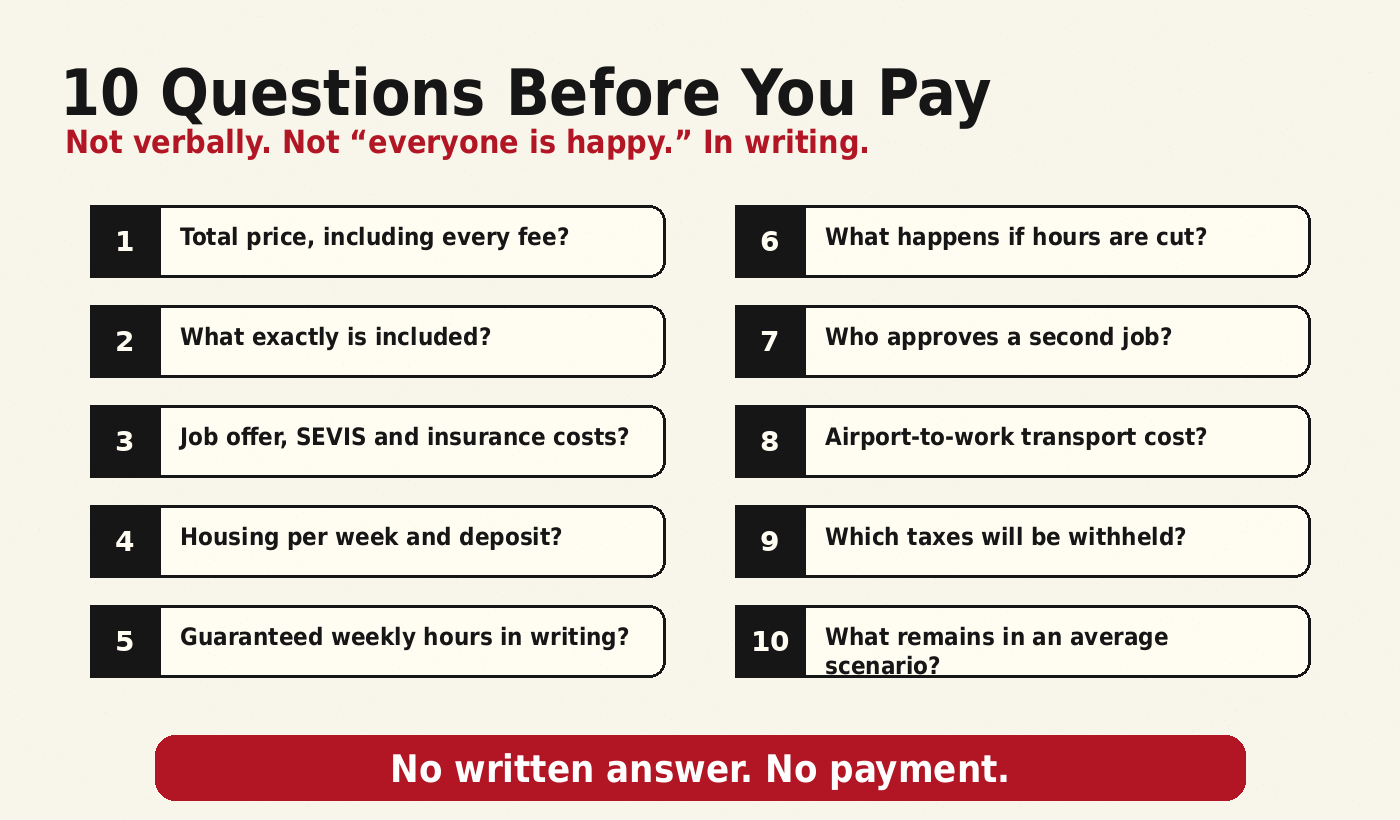
- What is the complete price, including every fee rather than only the “base price”?
- What exactly is included in that amount?
- How much do the job offer, SEVIS, insurance, registration and other “small items” cost?
- How much is housing per week, and is there a deposit?
- How many weekly hours are guaranteed in writing?
- What happens if the employer provides fewer hours?
- Can the student legally take a second job, and who must approve it?
- What is the realistic cost of getting from the airport to the job?
- Which taxes will be withheld, and what can actually be recovered?
- How much should remain after all expenses in an average—not perfect—scenario?
If the recruiter begins avoiding the questions, moving into motivational speeches, repeating “everyone is happy,” or accusing you of being too negative, you have learned something useful. Not that the program is necessarily good. You have learned exactly where the smoke screen begins.
Conclusion: money can be made, but not the way it is sold
Can a student make money through Work and Travel USA? Yes.
Can a student easily, calmly and reliably make the advertised $6,000–$10,000? That is where the fairy tale begins.
To bring home serious money, the student usually needs many hours, a second job, cheap housing, strict discipline, very low spending, a decent employer, a workable location, no health problems, compatible schedules and some luck on top. In other words, the result requires something closer to the ideal seasonal laborer than the ordinary program participant.
The agent needs much less.
The agent needs the student to believe.
Believe in easy repayment. Believe that “everyone comes home with money.” Believe that the taxes will return. Believe that the second job will appear. Believe that America will solve the problem.
Then sign the contract and pay the invoice.
That is why the most useful financial advice before Work and Travel is not romantic, but honest:
Do not ask how much you might make if everything goes perfectly. Ask how much you may lose if everything goes normally.
If the program still looks worthwhile after an honest calculation, that is an adult decision. Go with clear eyes—not as a tourist stepping into an advertisement, but as someone who understands the real price of the “dream.”
For a wider look at how the machinery around sponsors, agents, fees and the language of “cultural exchange” fits together, this detailed report lays out the larger structure.
Because the central Work and Travel question is not simply, “How much can I make?”
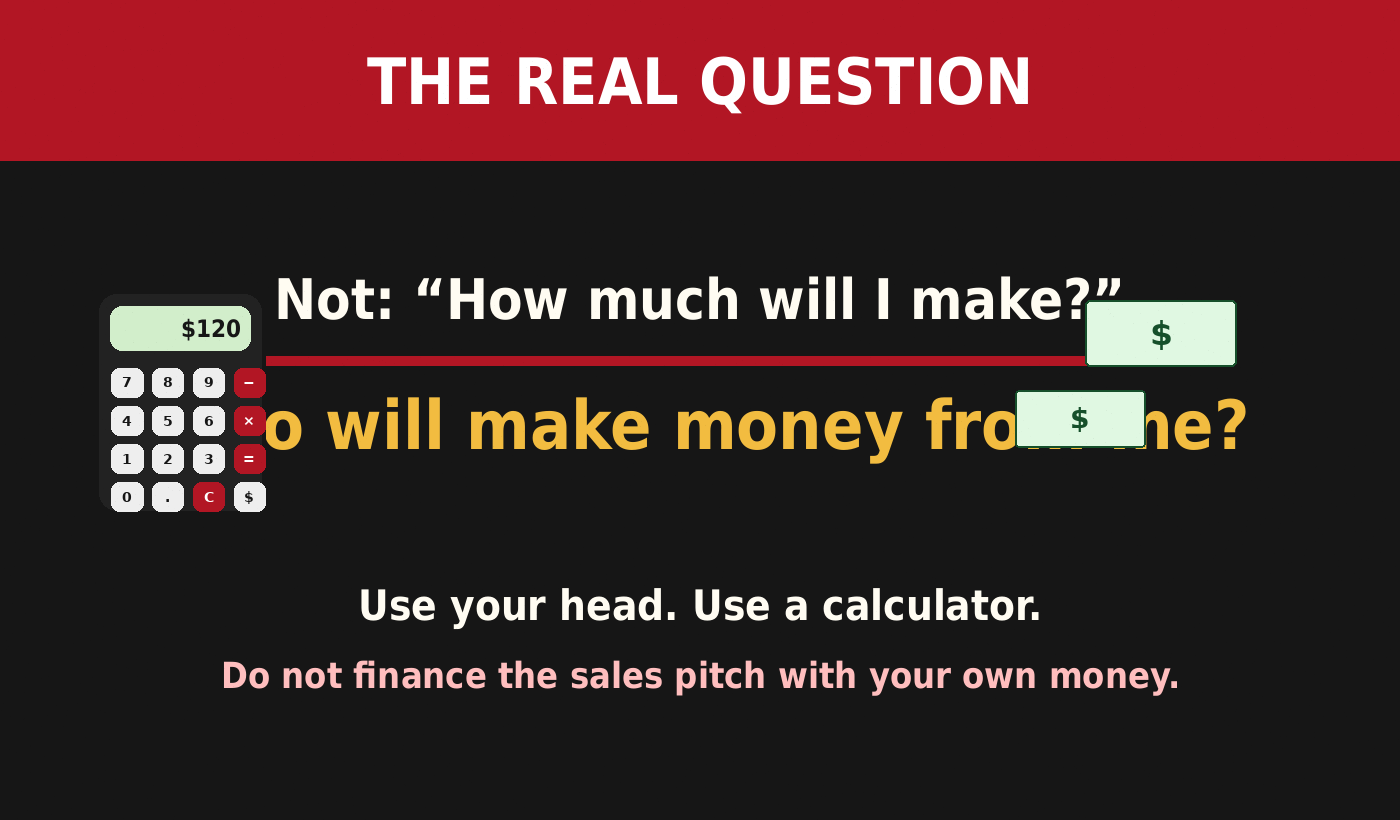
The real question is: who will make money from you while you are dreaming of making money in America?
Use your head. Use a calculator. And do not finance the sales pitch with your own money.
More essential reading about Work and Travel USA
Knowledge is power. These articles and book excerpts are worth reading before paying for the program:
- The Work and Travel money myth
- The English-language myth
- The career and international-experience myth
- The tax-refund myth
- The medical-insurance myth
- The cultural-exchange myth
- The J-1 visa interview and more than 100 commonly asked questions
- Why do students bring buckwheat to America?
- Sex. Money. Work and Travel USA. Part One
- Sex. Money. Work and Travel USA. Part Two
- “Niga, you have a dolar?”
- What does the press say?
- Murders and sexual assaults involving Work and Travel USA participants
- Greedy employers: how American companies profit from Work and Travel students
- SWT 2020: failed public diplomacy
- Russian SWT Roulette: an overview of the Work and Travel USA program
- Main participant categories: what is likely to happen in America?
- Real reviews from Work and Travel USA participants
- Global J-1 Summer Work Travel USA class-action lawsuit
- What does Work and Travel USA really cost?
- How much do foreign agents and American sponsors make?
- The Work and Travel setup that put students in an American prison for 30 years
- DarkNet WAT: how agents expose students’ personal data
- “Embarrassing and silly”: why Western Europeans avoid Work and Travel USA
- J-1 Internship/Trainee: another scam or something worthwhile?


