
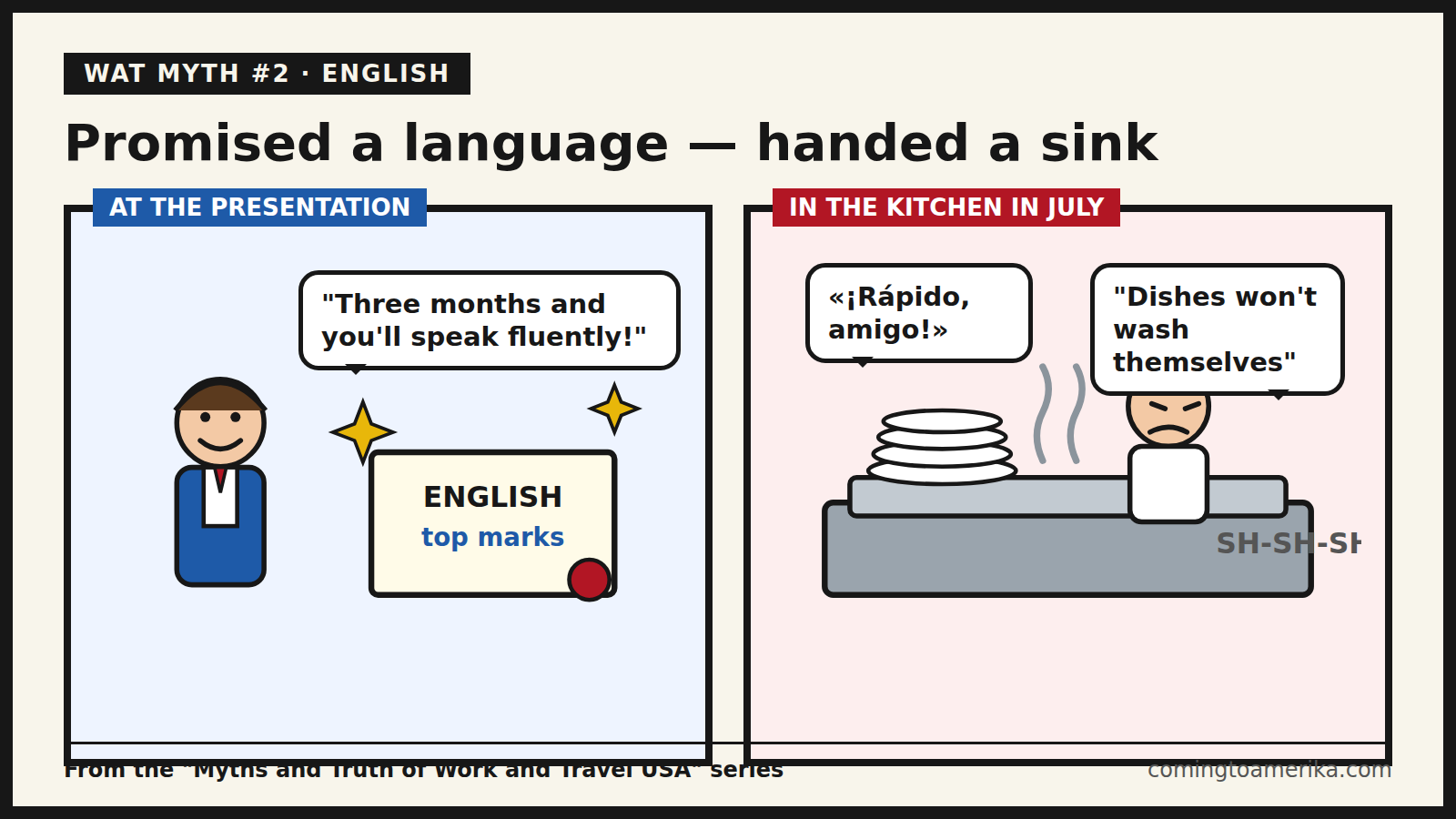
“Go to America for the summer and you’ll come back with fluent English.”
Sound familiar? Of course it does. Of all the promises agents use to lure students onto the Work and Travel USA program, this one is the most convincing. Most people have already heard the pitch about easy thousands of dollars and just smirk at it; the same goes for the “career at an international company” line. But language… language is sacred. Who would turn down the chance to level up their English in a single summer?
So today we’re taking that exact myth apart. Calmly, step by step, and without the marketing fluff.
Sounds tempting, doesn’t it? Sure. Let’s just take a look at what that “practice” actually looks like.
Let’s start with the good news: this is the most honest of all the myths
Credit where it’s due: out of the whole marketing song and dance, the promise about language is the closest to the truth. Your English really does move over the summer. The only question is by how much — and here, as usual, the ad and reality head off in different directions.
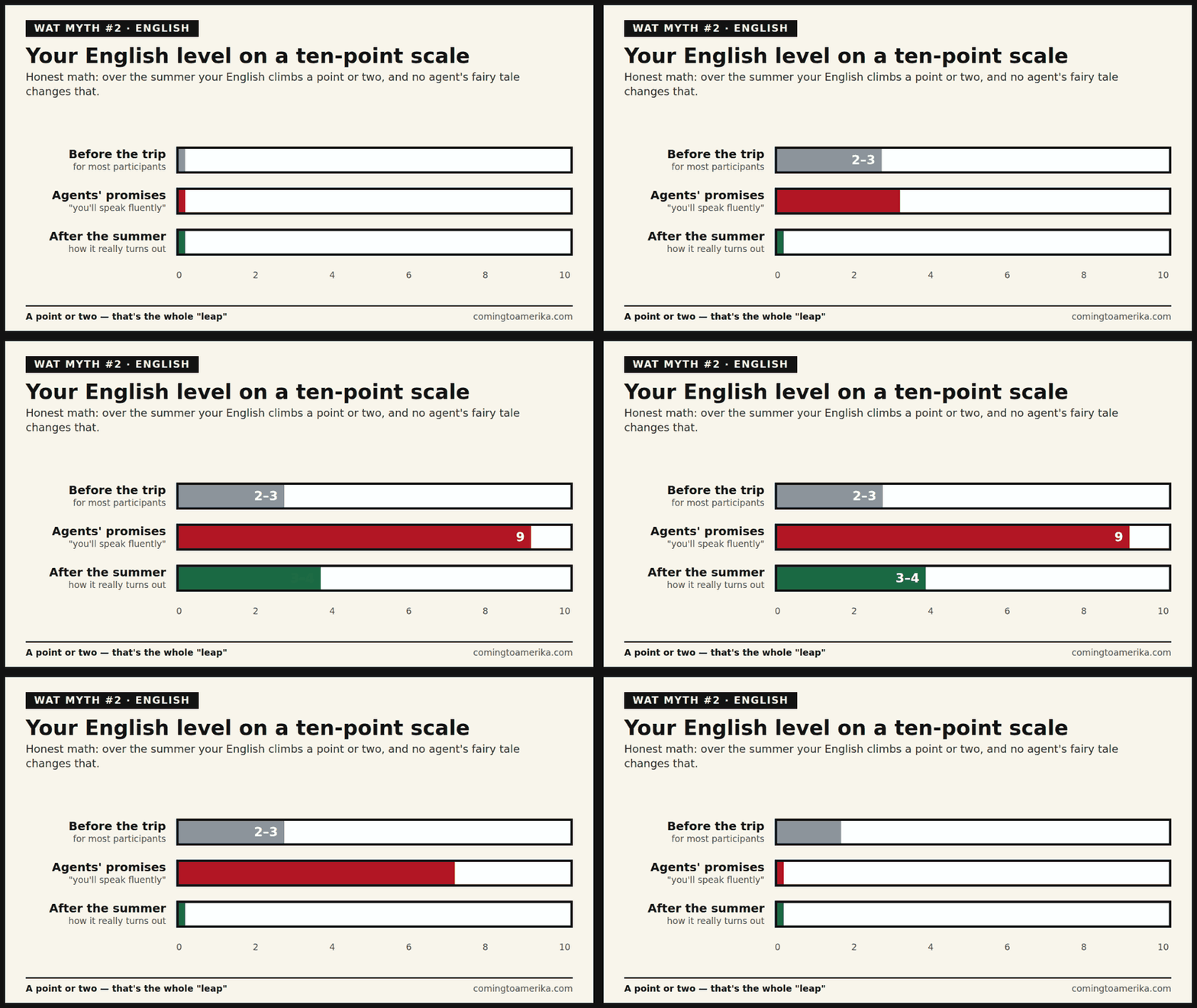
Take a typical case. Before the trip, most participants sit at about two or three out of ten. School, college, “I read and translate with a dictionary.” That’s normal — it’s where the vast majority start.
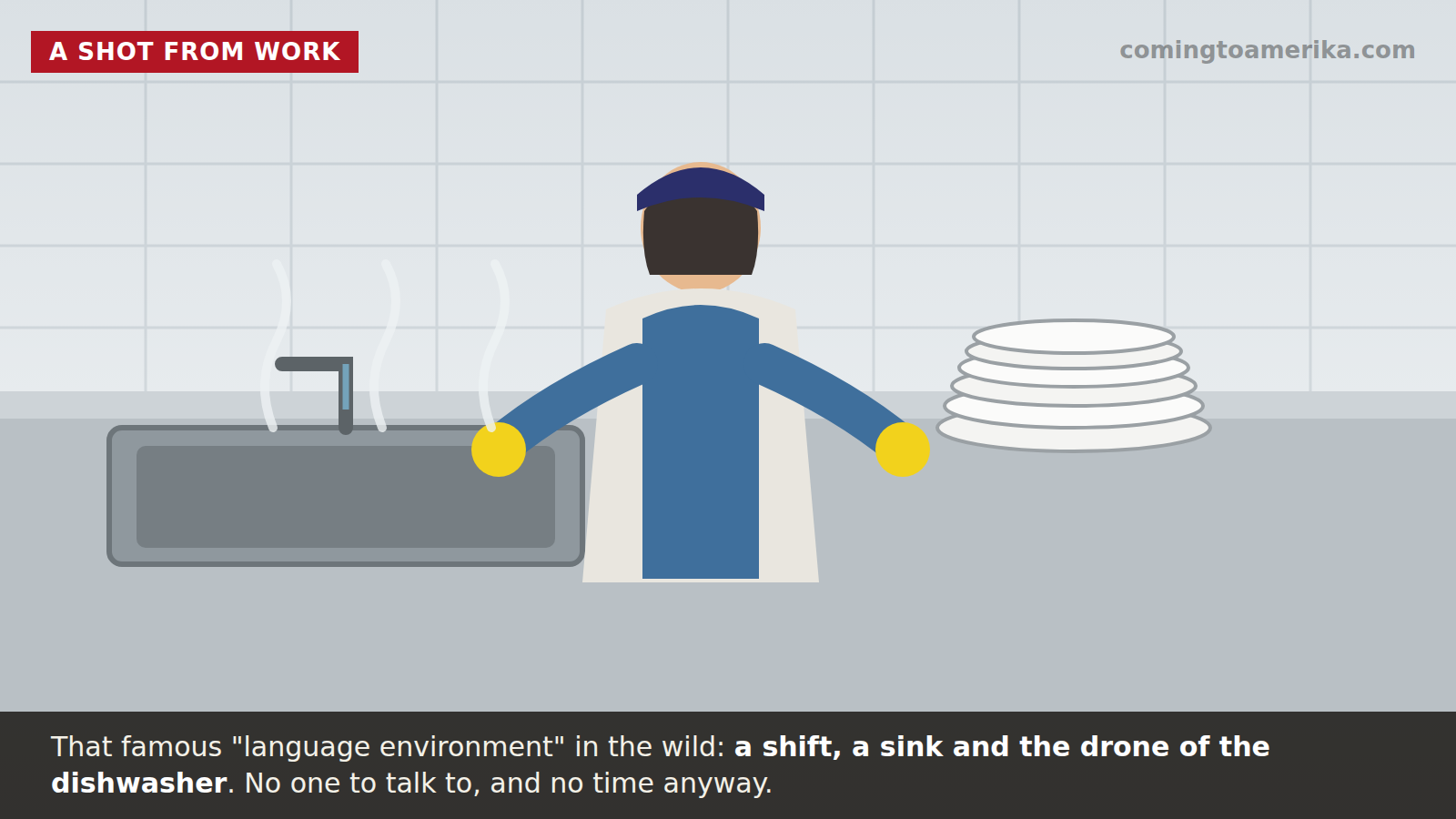
Now step up to the mirror and answer one question honestly: do you really expect to speak fluent English after spending the whole summer washing thousands of plates and scrubbing hundreds of toilets?
Exactly.
The language environment they keep quiet about at presentations
The explanation is simple: by the program’s terms you’re hired for the most basic, unskilled, low-paid work — kitchens, cleaning rooms, dishwashing, fast food, amusement parks. Locals who have a choice don’t take these jobs. So the people beside you will mostly be fellow newcomers — from Mexico, Cuba, the Dominican Republic, South America.
In many places the signs and notices are duplicated in Spanish — otherwise half the staff simply wouldn’t understand them. So don’t be surprised: your “language practice” will turn out to be broken English mixed with Spanish and hand gestures. Almost every participant brings this up — read their reviews: the stories are all cut from the same cloth.

Over to the participants themselves
Here’s how one participant answered the question of whether she managed to improve her English:
“Improve it? Hardly. I picked up some slang and spoiled the grammar I already knew — that much is certain. I studied in the geography department, finished a school with an advanced English track, and I especially wanted to work on the language. But it turned out there was simply nowhere to practice it. There are so many newcomers around, everyone with their own accent, and almost no one near me spoke clean English. The grammar and vocabulary I’d built up in school and college turned out to be useless. Most of our time at work we spent with Mexicans, listening to their conversations. In the end it’s not English at all, but some baffling mix of languages. And you’re asking me about improvement…”— Sveta, 2026
Another participant just laughed:
“Oh sure, we practice a foreign language all right! Except at work we speak Mexican. The housekeepers and all the support staff like us — everyone’s from somewhere different, but they definitely don’t talk to each other in English.”— Artyom, 2026
And a third summed it up with a sigh:
“I wanted so badly to work on my English, and in the end, hauling those plates around with the Mexicans, the only thing I worked on was my muscles.”— Danila, 2026
At home — your own language; at work — two-word commands
Now add the second half of the picture. To save money, students move in together — and, as a rule, with their own kind. The program funnels participants into the same resort towns, where you casually run into people from back home, even classmates. As a result, for most of the day your native tongue is what surrounds you. Some language environment — it’s basically a dorm with an ocean view.
Here’s how one more participant described it:
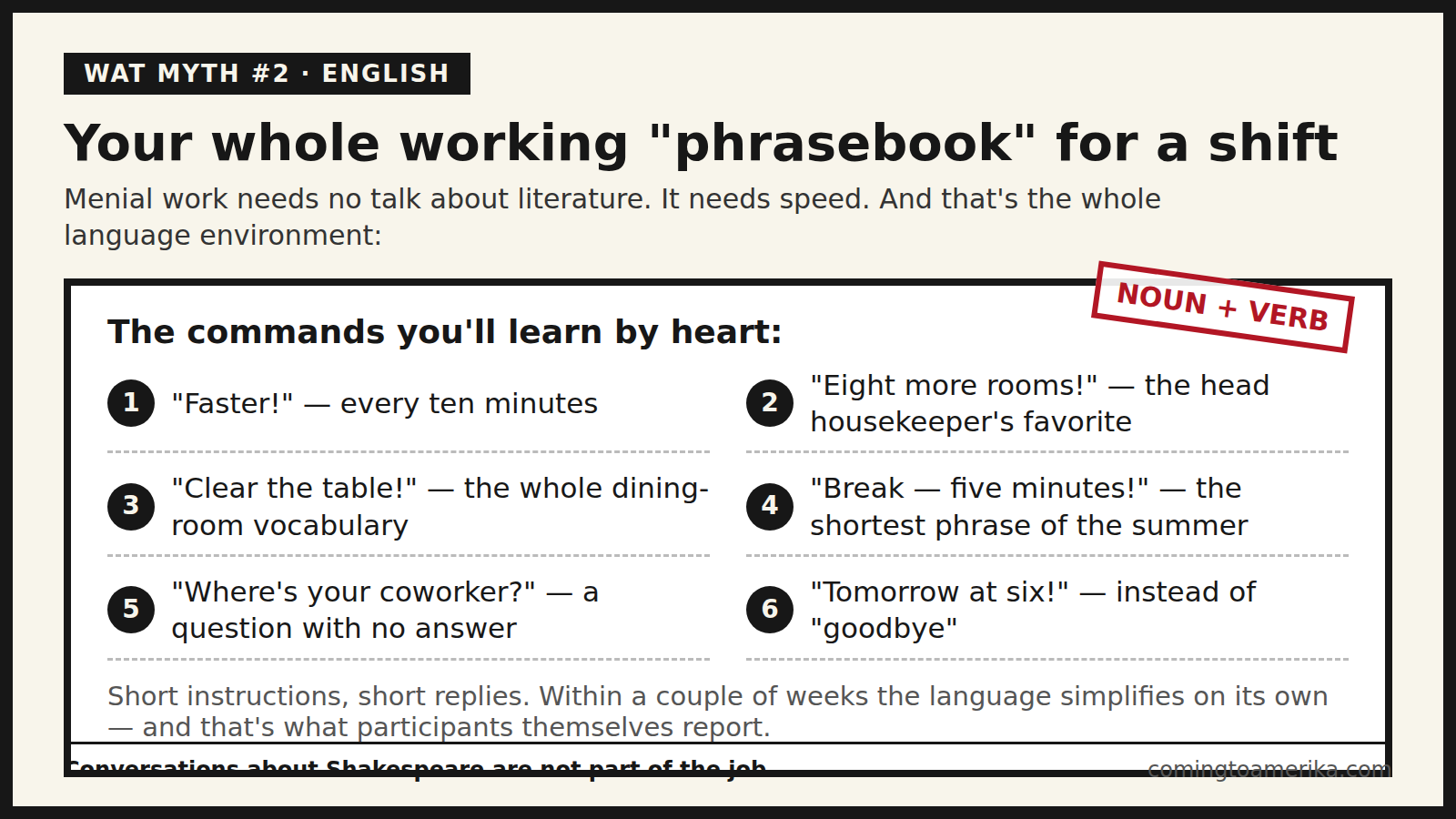
“The agencies that send students to America talk a lot about some kind of language practice. In reality there’s nothing of the sort. Most people live in apartments with other Russian-speakers: Russians, Kazakhs, Ukrainians, Moldovans. At home everything’s in your own language, and at work English boils down to a couple of words: a noun and a verb. Short orders from the boss, short replies — everything turns into the simplest phrases. You’re lucky if your coworker doesn’t speak your language, but even he’s no philologist. And if you’re washing dishes, the roar of the machine drowns out any conversation anyway. In no time the language simplifies itself.”— Marina, 2026
The honest bottom line: a point or two
So what’s the takeaway? After three short months of washing dishes, making beds and living side by side with your countrymen, your English climbs a point or two — from two or three up to three or four out of ten. That’s it. There are exceptions, but they’re rare and don’t change the picture.
And now — what you’ll actually get
And here comes the important caveat that made it worth reading this far. The trip does give your language something valuable. You’ll gain and build up a certain confidence in speaking. Some. Yes, it’s still broken English, but who cares? Locals will ask you to repeat yourself a hundred times — so what. The fear of opening your mouth goes away, and for a language that’s just about the main thing.
The ball is rolling — the rest is up to you. Grab every chance to speak English and your level will rise. This is proven across hundreds of participants. Just don’t expect to wake up one fine morning speaking fluently, the way the agents promise. Remember: you’re brought to the States for simple work that by its very nature needs almost no talking, and in places none at all.

A question and a straight answer
The three questions we get asked most. Tap any of them for an answer with no sugar-coating:
Can you come back from America with good English at all?
What gets in the way of language practice the most?
Is it worth going for the language and paying three thousand dollars for it?
Check yourself before you pay
And finally — a short self-check. Answer honestly, with no agents and no parents looking over your shoulder:
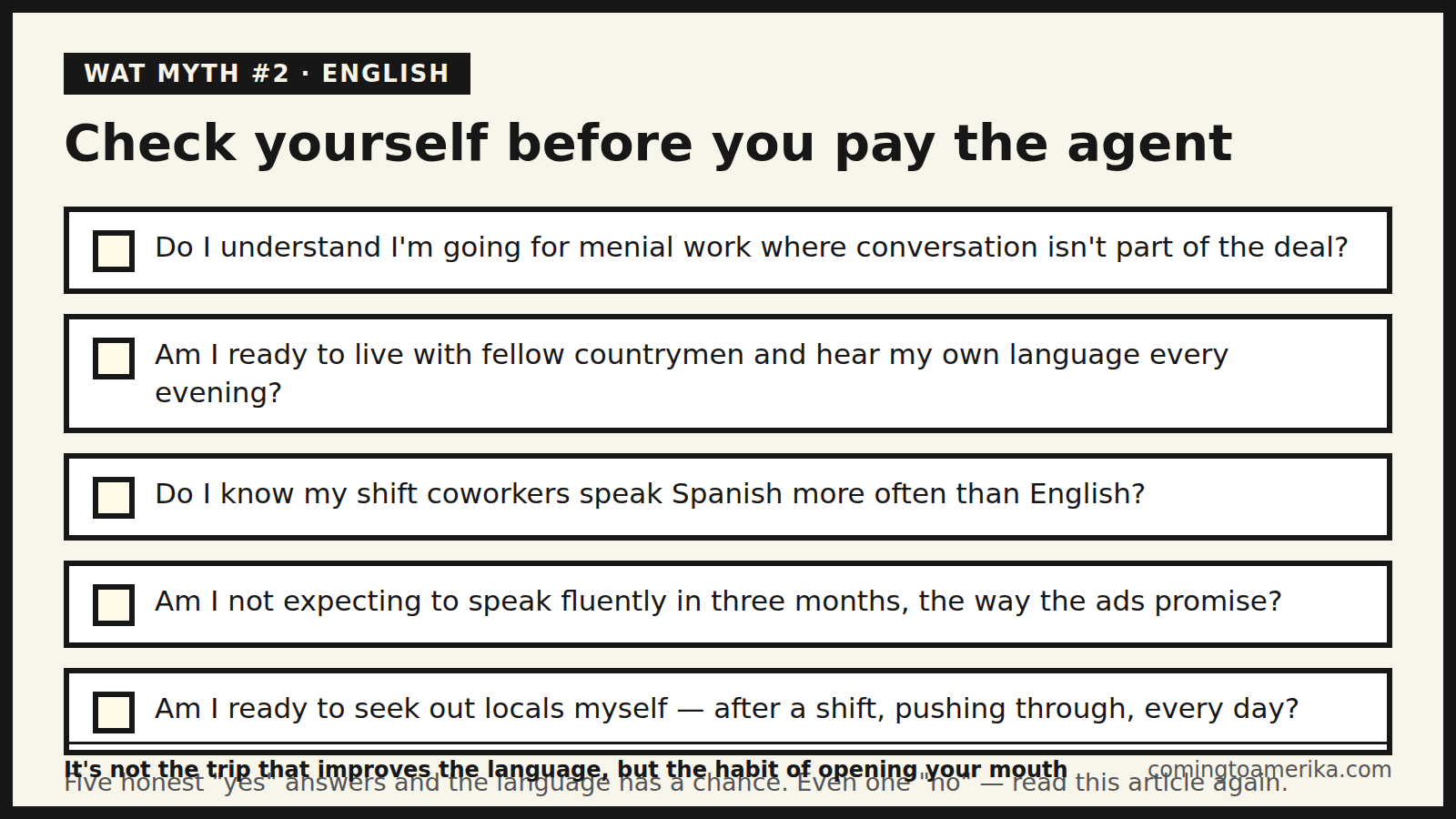
So there it is, another WAT myth about “leveling up” your English in a single American summer. Confidence you’ll bring home, a couple of kitchen commands you’ll learn by heart, but fluent speech you’ll have to earn yourself — at home or over there, but always through your own effort.
With that habit, English grows anywhere. Without it, it won’t grow even in America.
Either way, thanks for reading to the end. We genuinely wish you real improvement in your English — and good luck with everything!

More about the WAT program
Knowledge is power. So, to help students and their parents, here are some suuuuper useful articles and other excerpts from our book:
- The WAT myth about money and earnings
- The WAT myth about English language practice
- The WAT myth about career and international experience
- The WAT myth about tax refunds
- The WAT myth about medical insurance
- The WAT myth about cultural exchange
- The J-1 visa interview and a list of over 100 frequently asked interview questions
- Why do students bring buckwheat to America?
- Sex. Money. Work and Travel USA. Part One
- Sex. Money. Work and Travel USA. Part Two
- Yo, you got a dollar?
- What does the press say?
- Murders and rapes of Work and Travel USA participants
- Greedy Yankees, or how American companies profit off WAT participants
- “Deceived by America,” or how the State Department and agents cashed in on students during the pandemic
- Russian WAT Roulette: an overview of the Work and Travel USA program
- The main categories of participants, or what awaits me in America?
- Real reviews from Work and Travel USA participants
- The Work and Travel USA class action lawsuit
- How much does the Work and Travel USA program cost?
- How much do foreign agents and American sponsors of Work and Travel USA earn?
- The WAT setup: how students landed in an American prison for 30 years
- The dark side of WAT: how much agents sell students’ personal data for
- “Embarrassing and silly”: why Western Europeans don’t do the Work and Travel USA program
- The J-1 Internship/Trainee program: another scam, or something worthwhile?


