
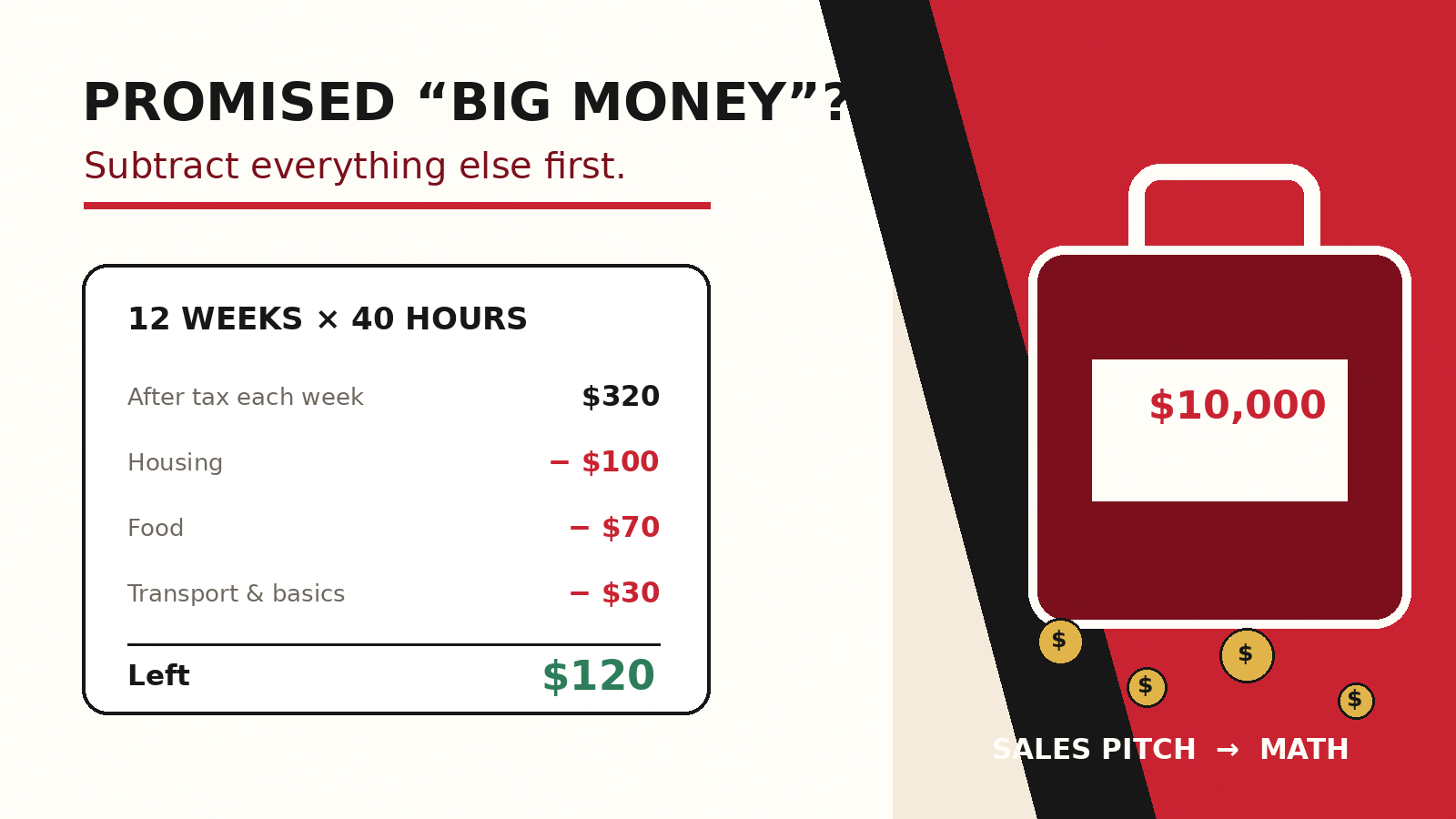
“You’ll make six thousand dollars over the summer. Ten thousand if you work hard. You’ll pay back the program in the first month.”
Sound familiar? This is the song students and parents have heard at Work and Travel USA presentations for years. America, dollars, travel, a new phone, and a triumphant return home with a pile of cash. All you have to do is pay for the program, get the visa, and board the plane.
There is just one detail the sales pitch prefers to hide: wages and earnings are not the same thing. Wages appear on the pay stub. Earnings are what remain after taxes, housing, food, transport, phone service, uniforms, deposits, local travel, and the cost of the program itself.
That final number is what we are going to calculate. No promotional videos. No borrowed photographs of somebody holding a new phone. No stories about a friend of a friend who supposedly brought home ten thousand dollars.
The real question is not “How much will I make per hour?” It is “How much money will be left after every unavoidable expense?”
The myth: “I will easily make $6,000–$10,000”
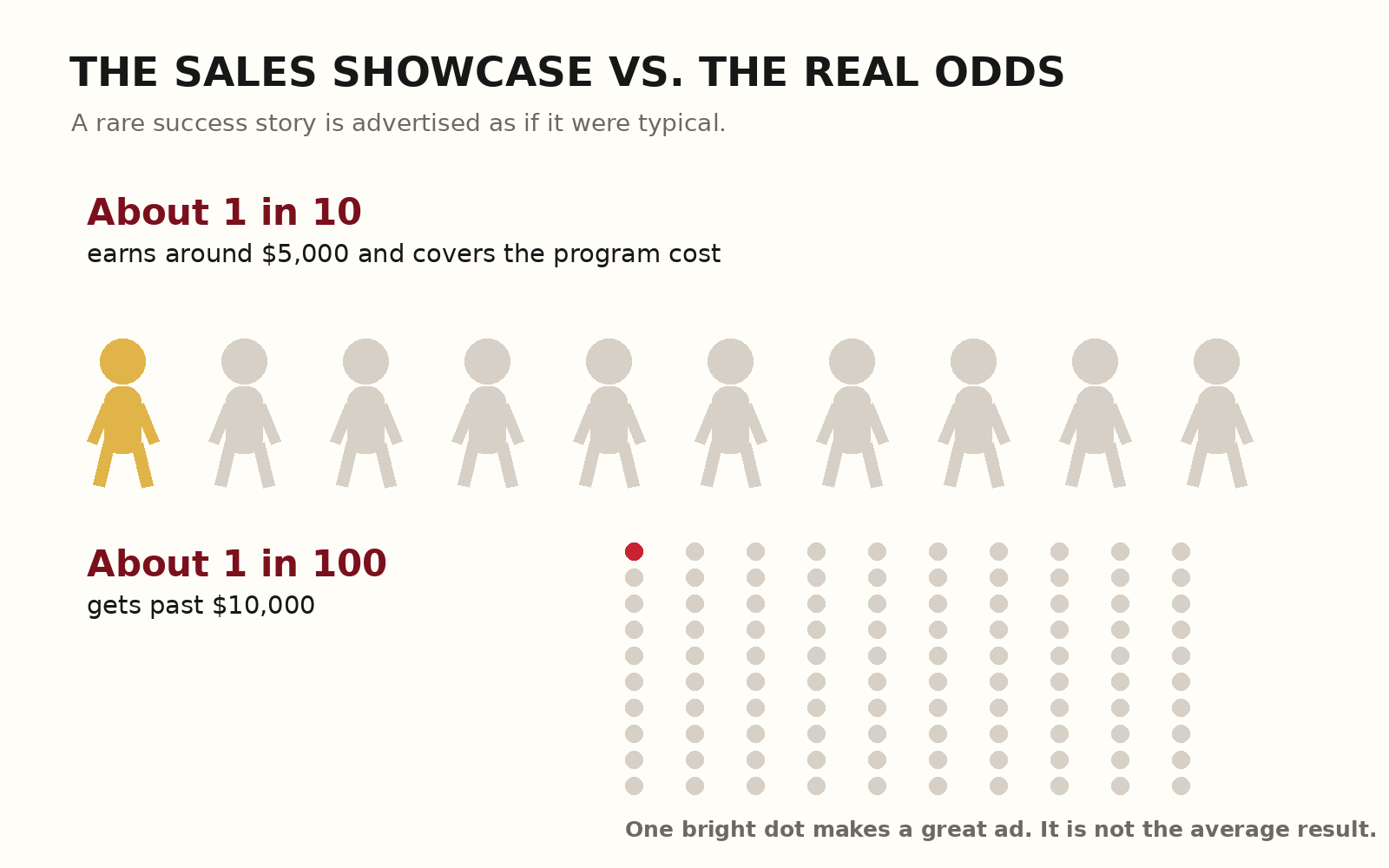
According to the figures already published on this site, roughly one participant in ten manages to earn about five thousand dollars and recover the cost of the trip. Roughly one in a hundred makes more than ten thousand.
Those people exist. The trick is that a rare success is presented as the normal outcome. One winner is placed in the spotlight while the other ninety-nine disappear from the story.
This is why “my friend made ten thousand” proves almost nothing. That friend may have lived for free, worked sixteen-hour days, received unusually high tips, arrived before everyone else, or simply landed in an exceptional situation. You are not buying your friend’s circumstances. You are buying a program at full price, with no guarantee that you can reproduce that result.
Let us calculate one ordinary job
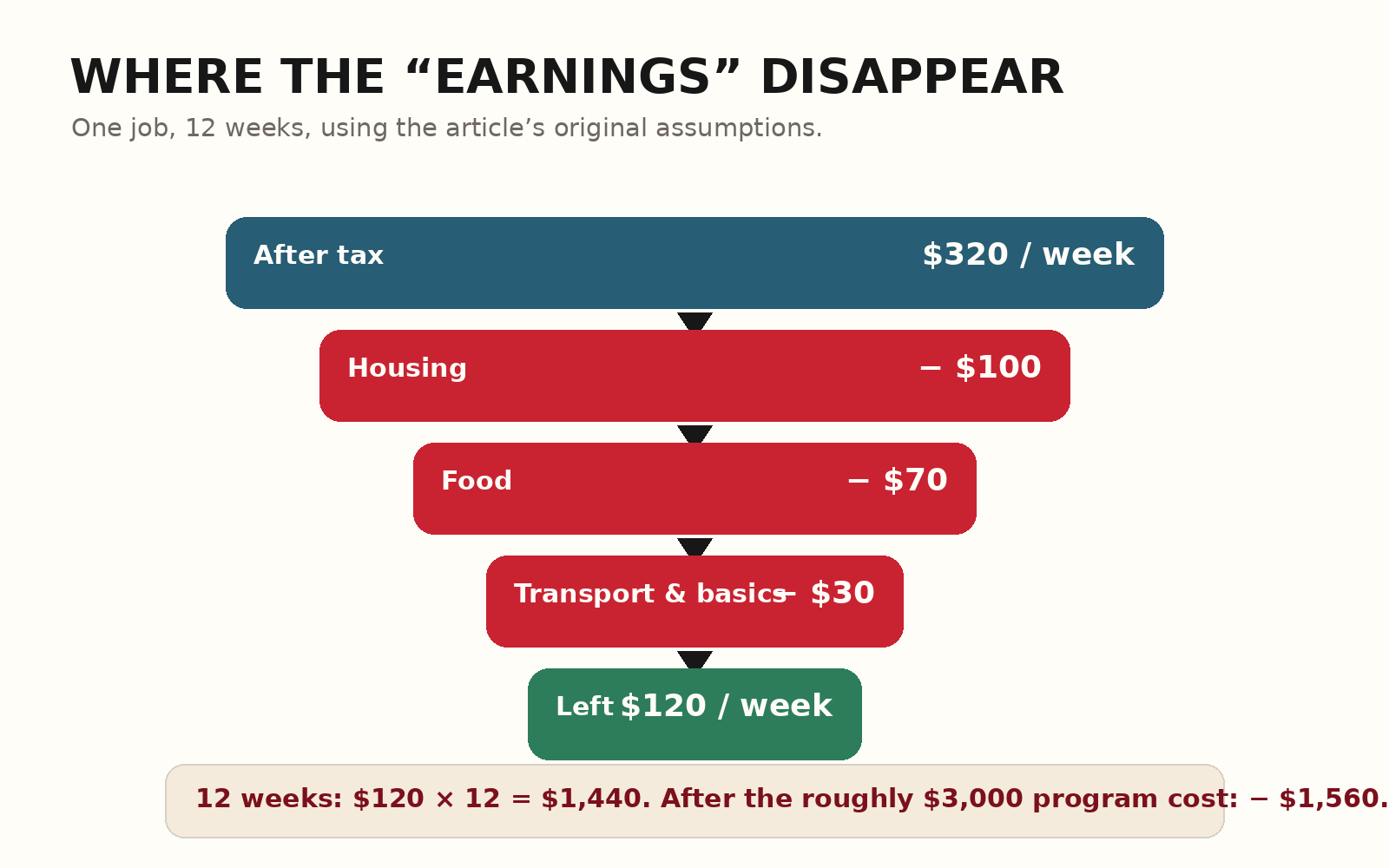
We will use the assumptions from the earlier calculation on this site: three months of work, or twelve weeks; a wage of about nine dollars an hour; forty hours a week; and roughly ten percent withheld.
After withholding, the weekly pay is about $320. That sounds respectable. Do not celebrate yet. The money is not really yours until the bills are paid.
A basic weekly budget looks like this:
- $100 for housing;
- $70 for food;
- $30 for transport, phone service, uniforms, household basics, and other small expenses.
The result:
Over twelve weeks, that leaves $1,440.
Now subtract roughly $3,000 for the program and the trip:
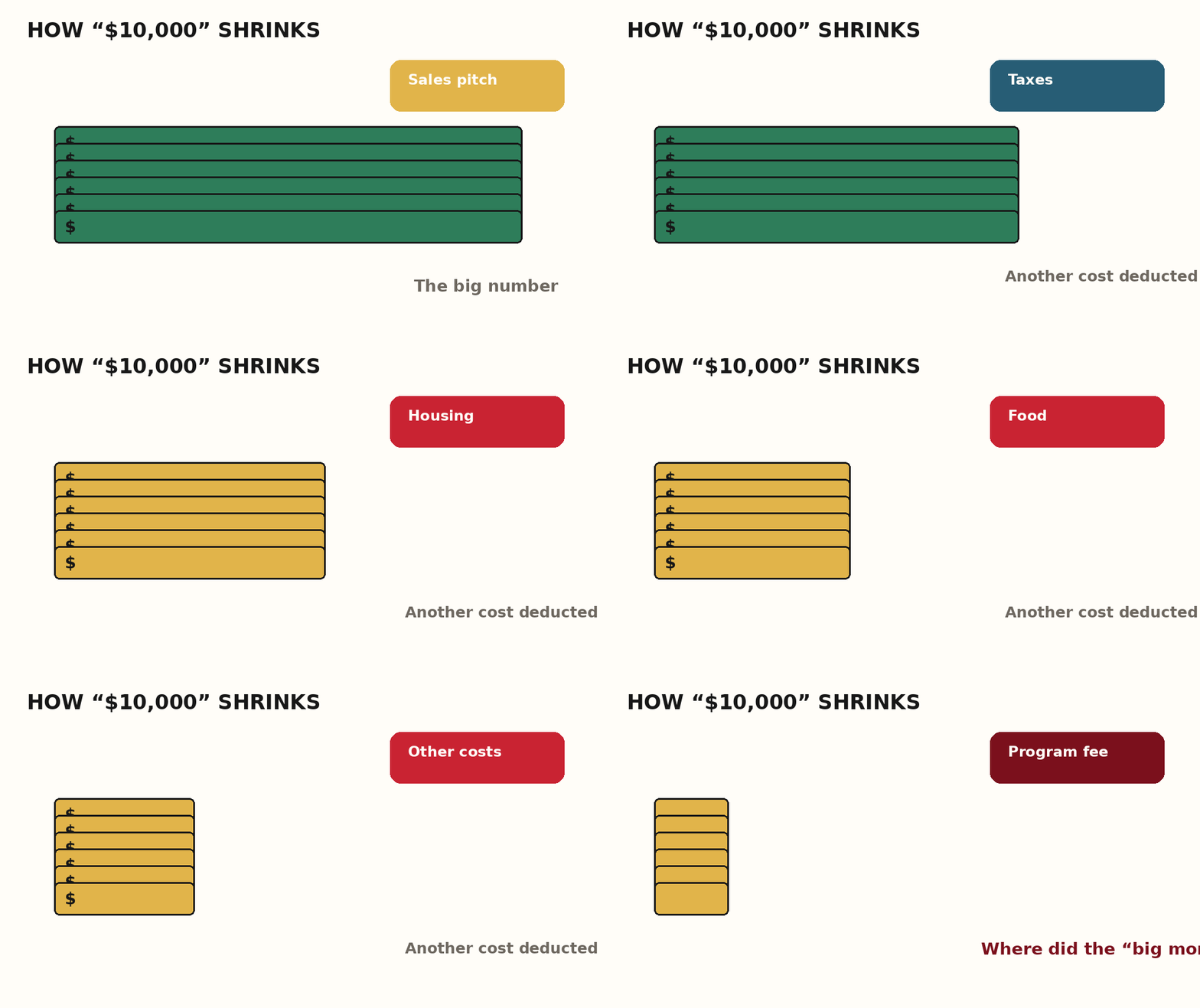
$1,440 − $3,000 = − $1,560
That is not “pure profit.” It is a loss.
That is the entire magic trick. The presentation shows you the dollars that may pass through your hands. The calculation shows you the dollars that may remain in your pocket.
What happens when expenses rise?
The updated version of the original article makes another important point: the old calculation used pre-pandemic costs and suggests adding around thirty percent to expenses. Not to wages. To expenses.
Under the same assumptions, weekly costs rise from about $200 to about $260. The weekly remainder falls from $120 to roughly $60. Over the summer, that is about $720. After the program cost, the final result is about − $2,280.
Every participant will have different numbers. The direction is still obvious: the more housing, food, and transport cost, the faster the advertised “thousands” disappear.
How many hours does it take just to break even?
Now we reach the most revealing part. At nine dollars an hour with the same withholding, a standard forty-hour week is not enough. To cover ordinary living expenses in the United States and recover roughly three thousand dollars spent on the program, you need about 56 hours of work every week.
If expenses are increased by thirty percent, the requirement rises to roughly 63 hours a week.
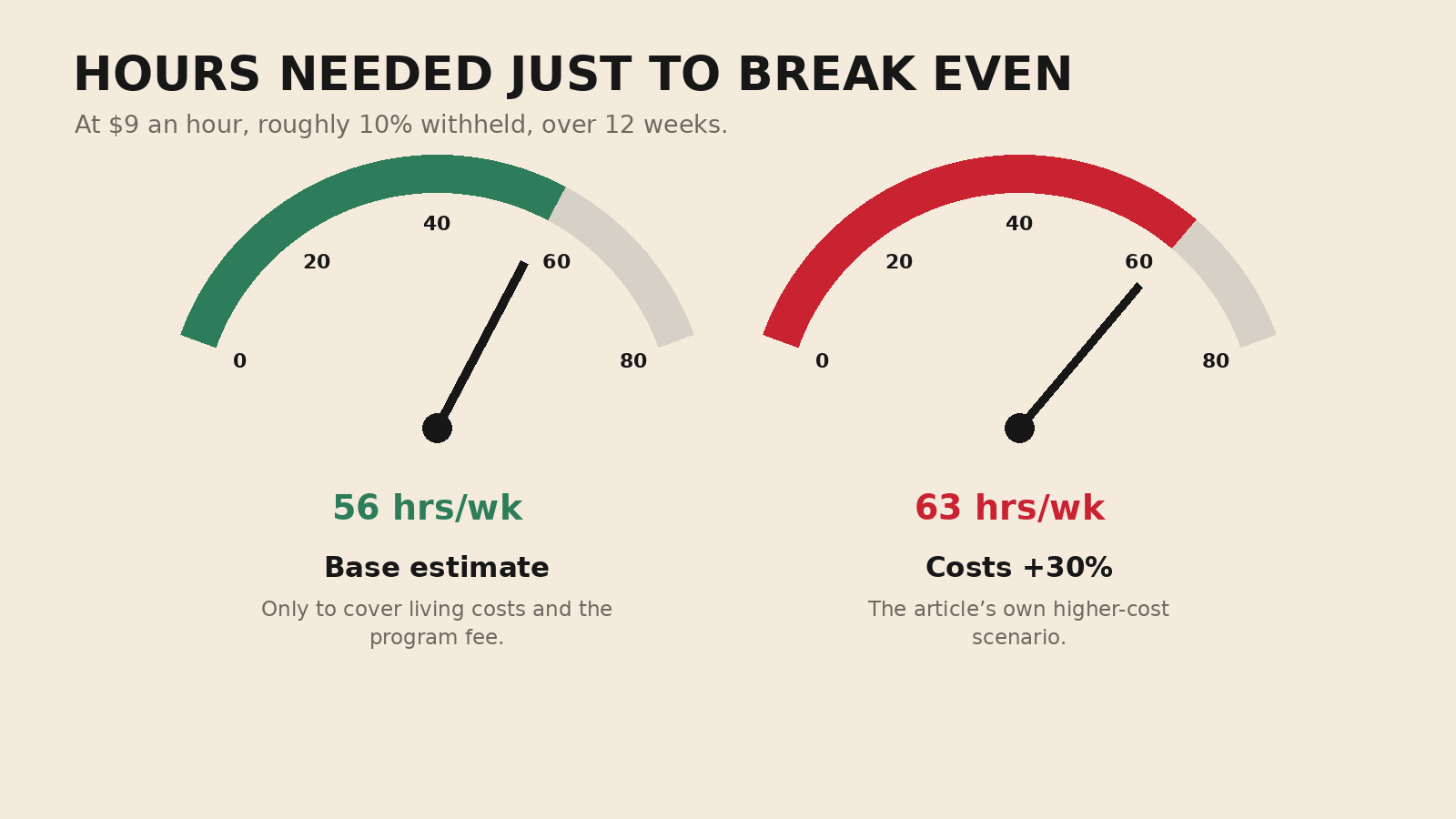
That is the difference. The sales pitch says, “You will work and make money.” The math says, “First work roughly one and a half full-time schedules just to recover what you already spent.”
You were supposedly going to America for more than work. You were promised travel, English practice, a new country, and a “cultural exchange.” But after more than sixty hours of work each week, the choice is no longer between New York and California. It is between sleep and another shift.
Three possible summers
One job
About 40 hours a week.
You may cover daily life, but the program cost remains unpaid. You return home with memories and a financial loss.
Two jobs
Roughly 60–80 hours a week.
You have a chance to break even. Travel, rest, and the promised “cultural exchange” gradually disappear from the schedule.
Rare good luck
Strong hours, good tips, cheap housing.
You may earn much more. This is exactly the case an agent will enthusiastically show the next group of students.
Why “you will pay it back in a month” is especially dangerous
Because it changes the family’s behavior before the student even leaves. The student and the parents stop treating three thousand dollars as a real expense and start treating it as a temporary advance. It will all come back next month, they are told. That makes it easier to borrow money, accept extra fees, and avoid uncomfortable questions.
Then the student arrives and learns that forty hours were never guaranteed, housing costs more than expected, transport is necessary, deductions come out of every paycheck, and a second job still has to be found and approved.
By then there is no easy way back. The money is paid, the ticket is bought, and the debt is real. This is the moment when the participant becomes especially convenient labor: willing to take extra shifts, tolerate poor housing, and keep quiet simply to avoid returning home in the red.
The broader machinery behind those promises is examined in this detailed investigation of the Work and Travel system.
What to check before paying
1. How many hours are actually guaranteed?
Not “usually forty,” and not “there is plenty of work in season.” Ask for the exact number in writing. If the hours are not guaranteed, calculate the worst case.
2. What does housing cost in full?
Ask about weekly rent, deposits, utilities, number of occupants, distance to work, and the conditions for getting the deposit back. “Housing provided” does not mean “housing free.”
3. What will be deducted from the paycheck?
Taxes, uniforms, employer transport, meals, housing, training, document checks. Ask for the complete list before you pay for the program.
4. Is a second job realistically possible?
Check the approval process, distances, transport, and the schedule at the first job. “You will find something after you arrive” is not a plan. It is a hope.
5. What is the full cost of the trip?
Do not count only the agency fee. Add the visa, government charges, airfare, travel to the job, the first weeks of living expenses, deposits, phone service, local transport, and costs after returning home.
The formula the sales pitch does not show
The real result of the trip =
(hourly wage × paid hours − deductions − living expenses) × number of weeks − total program cost
Put your own numbers into that formula. Not the agent’s numbers. Not the best participant’s result from last year. Not a beautiful gross-pay figure. Your own numbers.
Calculate three versions: good, average, and bad. If the trip pays for itself only in the good version, then this is not a reliable earning plan. It is a bet on luck.
Conclusion
The problem is not that nobody can make money through Work and Travel USA. Some participants do. The problem is that a rare success is sold as the normal outcome, while the price of that success—two jobs, extreme saving, and almost no free time—is hidden behind attractive photographs.
Before paying, forget America, the new phone, and the travel photographs for five minutes. Open a calculator. Enter the wage, guaranteed hours, housing, food, transport, deductions, and the full cost of the trip.
If the “big money” still survives the calculation, excellent. If it turns into a small remainder or a debt, it is better to learn that at home than in the middle of the summer in a foreign country.
Calculate first. Pay second. In that order.
More on Work and Travel USA
- The myth of English-language practice
- The career myth
- The tax-refund myth
- The health-insurance myth
- The cultural-exchange myth
- What does Work and Travel USA really cost?
- Real participant reviews
- Deaths, assaults, and serious risks
- The global J-1 class-action lawsuit
- Russian Work and Travel roulette


