
 Everyone who has been promised “pile of cash” in the Work and Travel USA program read further, this is for you!
Myth № 1:
I can easily make $6,000, and $10,000 with little extra effort. I recover program costs (~ $3,000) in one month
Sounds amazing, doesn’t it? Sounds just awesome … It only sounds … But here is a sobering and rather sad statistics:
Usually 1 student out of 10 actually earns $5000 and pay back the cost of the program.
Only 1 student out of 100 brings back more than $10000. This is so rare that even swt agents use those people as a successful examples in their marketing campaigns. They always say you can make $10000 but never say how difficult it is. More importantly, they never say what student should do to earn that much.
Work and Travel Calculator
Calculation of earnings in the Summer Work and Travel program
To dispel this myth, let’s do a fairly simple math based on 3 months or 12 weeks of a work program. Why 3 months? The main reason is of course participants’ school commitments. Second, the summer tourist season in States is gaining momentum around June and slows down towards the end of the August. Then, school in the States begins around the August 20th, therefore, many American families start to wrap up their vacations in August. That is why swt students are in most demand in the summer from June to August. You can of course arrive early and leave later, but then there will be less working hours and less chances to find a second job. Moreover, because of final exams and other school commitments it is typical for students to start working not earlier than June and finish early in September. With such tight schedule, some students also want to leave some time for traveling and sightseeing. Therefore, it is logical to calculate the participant’s earnings based on 3 months of work. [1] So let’s go – turn on your brain and calculator 🙂
Earnings from one job, per week: $313
Work hours: If you are lucky, you will get full 40 working hours per week. Most of the companies limit working hours and do not allow to work more than 30-40 hours per week. There is a constant fight for working hours. There are tons of half-legal immigrants from Latin America willing to work for 6 $/hour and sometimes even less. So don’t expect to get an overtime at 1.5x pay rate, it is quite rare. What is not rare, though, is that you are “politely” asked to work overtime but be paid at regular rate. Or get less than 40 hours. Ether way, for this example, we assume standard 40-hour work week.
Wage: The range of wages for Work and Travel students is quite narrow, since by the program terms you are supposed to be working at low-level and unskilled positions. This is explained in detail in the Career Myth. Therefore, any job offered by agents with a pay of more than ~$13 per hour is highly questionable. Either this is a state with very high living expenses, or it is a prohibited job that may cause problems in the future, or it is just another marketing lie.
It is important to note here that if you are offered a job with higher hourly pay in a different state, you should remember that all living expenses will likely increase proportionally. For example, wages in the south of the country, somewhere in Alabama or Texas, are certainly lower than in the northeast of the country (Massachusetts or New Jersey). But it should be understood that the cost of housing, food and other expenses in Alabama is lower than in more expensive states. In general, your pay rate from job offer is like an indicator of the relative cost of living in different states. You can compare the proposed wages at the typical housekeeper position in different states and conclude where living expenses are higher or lower. For example, no one in Texas or Alabama will pay $11 an hour to housekeeper with no experience, it is a fairy tale, but living there is relatively cheap.
Let’s say your pay rate is $9 per hour.
Taxes: swt participants will have to pay minimum 10% of federal nonrefundable taxes, (see taxes). The majorly of participants work in states that also withhold states taxes, some of them unrefundable. Swt agencies usually charge a fee of 10% or $100-150 to refund taxes, making certain percent of state taxes essentially nonrefundable. Also, cashing out actual tax refund may entail bank fees. Therefore, for the average earnings calculation we assume tax rate is 13%.
After paying 13% of taxes, the net hourly wage is (100-13%)x$9.0=$7.83. After multiplying that to 40 we get around 313$ per week. [2]
Expenses per week: >200$
Housing: 100$
Cost of living is quite high and varies a lot. Most likely you will end up living with other students to save money. The more people live in the house, the lower the rent of each resident – that is pretty logical. This is not a bad option but not a good one either as you will mostly live with compatriots or other foreigners. The rent often depends on personal preferences. There are guys who are ready to sleep on the floor with bugs and live in a Ghetto or Hispanic area in order to save more money. And there are those who are willing to pay $150 per week for an apartment with a pool, gym, a beautiful view, closer to the downtown work/shopping, separately from everyone, etc. So the range of housing fees is quite wide. Next, if you are told that housing is free, then most likely the cost of living will simply be deducted from your salary. Or get ready to live in a barn, attic, sleep with other students in the same bed and wait in line to use restroom. Importantly, let’s not forget that swt participants work in resort locations during tourist season where and when housing is relatively expensive.
Let’s say, approximate average cost of housing is $100 per week. [3]
Food: $70
If you don’t cook at home, eat junk and in fast food places, it will cost you around 10-15$ per day, assume minimum 70$ per week.
Other miscellaneous: $30
Sky is a limit here and expenses really depend on your self-discipline. Some costs, however, are out of your control and you have no choice, and some fees are hidden. Remember, nothing is free in States. Moreover, many Americans charge naive foreign students 2-3 times higher than the market rate or come up with payments that never existed before. Here we consider only mandatory expenses. Most common expenses include work uniform, training/certificate fees, rental insurance and housing deposit (that you usually do not receive back fully), utilities (ac, water, electricity), housing supplies (sheets, pillows, mattress, dishes, furniture), services like cable TV, Internet and cellphone/landline; transportation (bicycle, bus, train, subway, taxi, employer provided transport), sponsor vetting additional jobs, trip to get SSN, clothing and other unexpected/hidden fees. Also from the airport you need to get to your work place and back ($200-400). After summing up alls miscellaneous expenses and diving by 12, assume with optimism, $30 per week.
Total earnings, per week
Now to calculate net earnings we just subtract all expenses from the weekly gross earnings:
Weekly salary after taxes – housing expenses – food expenses – other miscellaneous expenses
313-100-70-30=$113 per week.
Total earnings, per trip
Next, we multiply weekly earnings by 12 working weeks so we will get total earnings for entire summer
113×12=1356$
No, wait, no, no, wait a second, but where is my promised average $6000???
I just spent $3000 and half a year preparing for the trip…
I still need to pay back my parents and travel, right?
And I have to post those glamor pictures on my facebook and instagram…
And buy a new iphone, gucci bag and fancy levis jeans…
Parents usually don’t get their money back, since their responsible children prefer to travel and buy a latest iphone. It is ok parents, forget about your $3000, you knew you won’t get your money back, right? And instead of promised $10000, naive students are coming back with one iphone, in the best case scenario. They usually sell it next month for cash though. Or yeah, forgot to mention those fancy levis jeans – their exact destiny is unknown…
Sooooo…By doing this simple math, you can see how easy to dispel the myth of “average and easy” $5000 earnings and almost cosmic $10000.
Let’s summarize
Following the outlined above logic, we can easily compose two tables that approximate the monetary fate of swt participants. The calculation is relatively simple and you can do it yourself for your own scenario pretty quickly 🙂
The first table below is the calculation of the earnings after deducting minimal necessary costs of living in the US.
The second is the evaluation of the payback of the program costs, that is, earnings after deducting the total cost of the program.
The input data for the calculation shown in tables is provided below. Of course, each participant’s calculation will be slightly different: some pay more taxes, some spent less on housing, etc. Pretty much everything discussed above is a variable input but it does have a range. Program participants work at low-wage unskilled positions – so the pay rate is limited. Also foreign students are not slaves and deserve appropriate housing conditions and nutrition. Calculation below is an average scenario and therefore a good approximation for the most the program participants.
Program cost is all money spent by participants in order to come and live in US before getting their first paycheck. Participants per rules when heading to US must take with them money (varies, ~$800). When determining program payback the “program cost” does not include funds spent by participants before receiving their first salary. Note also traveling expenses after the work period and costs associated with any cross-cultural activities are not factored in. This a pretty “dry” scenario calculation.
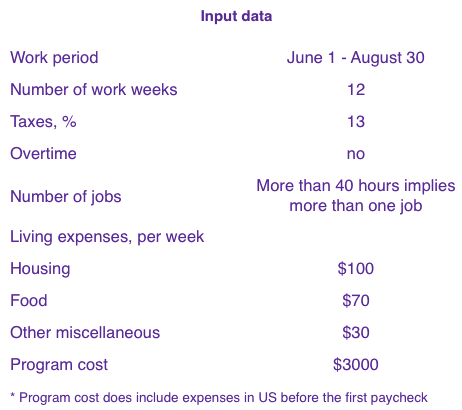
Now, you can open your job offer and look the wage and the number of working hours per week. This way you can approximate your earnings (first table) and evaluate the payback of the program (second table). If according to the second table you are in the red zone, then the earnings will not pay off the program costs and you will have a debt 😦 If in the green zone, then it’s super and you are a lucky hard working person 🙂 !!! All the surplus money in the green area you can use for whatever you want!

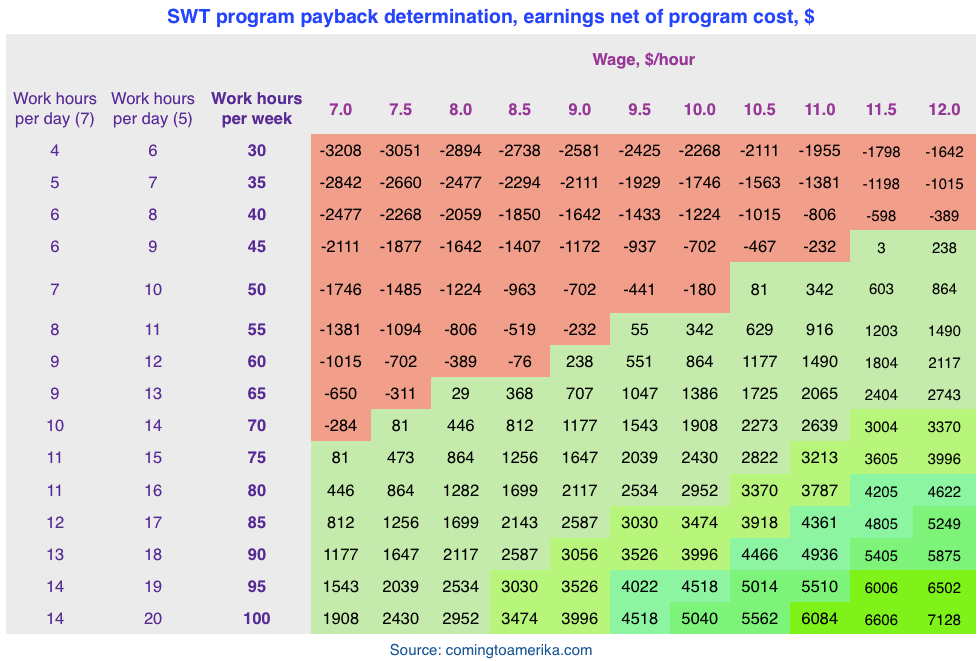
For example, if your wage is 9 $/h and you work at one job for 40 hours a week, then your total earnings for the summer is $1,358, the program will NOT pay off the program costs and you will have remaining debt of $1,642.

Certainly, there are several assumptions in this calculation but overall it perfectly debunks the program’s myth about high earnings.
Internal notes
1. Work Period
-
Large sponsor cites 13 weeks as a “typical duration” of the job availability for Russian swt participants. It notes however that students may not miss class thereby rendering program duration shorter. Source
-
Typical 12-week work period is evidenced by swt agents’ presentations, feedback from participants and personal experience.
-
According to program rules participants must return home by time their studies begin in school (see CFR)
-
Quickly finding additional job is hampered by following factors: students’ low English skills, adaptation and culture shock takes time, it takes about 2 weeks to obtain SSN, vacation peaks start in late June-July and slows toward the end August
2. Gross earnings from the job
-
2016 DoS report: “Complaints about low hours are consistently the most often complaints received by the Department, particularly in the beginning of the season (i.e., June for the summer, or December for the winter), before the tourism season really begins to pick up. Exchange visitors expressed concerns about inconsistencies in the number of hours promised in their job offers, compared to the number of hours they received from host employers.”
-
Internal note: in159
-
Confirmed by participants and personal experience.
3. Housing
-
200 arriving workers pay up to $110 a week to stay with local hosts. Source
-
Employer provided housing costs $100 a week. Source
-
The eight students have paid $350 a month each for an apartment, one they say wasn’t furnished with all that had been promised. “We have no linens, no utensils, no pots, no pans, no TV or radio”. Source
-
“I think that the rent here is kind of expensive. With one job I think you are unable to pay the rent for a week,” student said. “We’ve had housing situations where there have been 11 students in a three room house with one bathroom, a man keeping students in the attic, not furnished, no air flow,”. “And of course, the usual keeping of deposits.” Source
-
Average Rent Amounts per Season. Source
-
Paid $90 a week for room infested with bedbugs and had a malfunctioning air conditioner, with 7 other students and sleep two to a bed. Source
-
Internal note: in159
-
$90-150 per week plus $200-300 deposit. Source
-
$142 per week or $1700 per season, 10 people/house, 2 people/room . Source
-
These are the average assumptions. Forcing students into inhuman slave-like living conditions contradicts the spirit of the swt program.
-
$80-120 per week plus $200-500 deposit. Source in14.
-
Confirmed by participants and personal experience.
3. Food
-
n/a
4. Other miscellaneous
-
Used bicycle – $35. Recycled sheets, towels, pillows and a blanket – $30 per person. Source
-
Transportation provider charged nearly $650 for the summer. Source
-
See also “About Money” internal note
These are average assumptions. Forcing students into inhuman slave-like living conditions in US contradicts the spirit of the swt program.
5. Program cost (does not include “start up” funds – money taken with participants)
-
Internal notes
-
Program cost does not include money that participants are required to take with them in US before they get their first paycheck (minimum $800-$1000).
6. Additional information validation sources
-
See “About Money” internal note regarding sponsor-provided budget sheets/forms
PLACEHOLDER
Disclaimer
Any information on this website is intended for the general informational purposes only and for the audience of 18 years old and up. It is not intended to provide any kind of legal advice or recommendation. The book and any information on this website is not a substitute for any type of professional, legal, immigration or any other advice or recommendation and cannot be considered as such whatsoever. The authors, sellers and copyright holders assume no responsibility for any omissions or errors whatsoever. You should use the book and any information on this website at your own fitness and risk only. Any view, opinion, data or other information on this website is not warranted as to completeness or accuracy, is subject to change without notice and authors, sellers and copyright holders accepts no liability for its use or to update or to keep it current. Any views or opinions, described in the book and on this website, might be those of individuals interviewed, and are not necessarily of the authors, sellers or copyright holders. The authors, sellers and copyright holders also disclaim any implied warranties of fitness of the book and any information on this website for any particular purpose and shall in no event be liable for any losses and/or damages arising from the use or misuse of this information. You should not act or refrain from acting on the basis of information in the book and any information on this website without seeking legal counsel from an experienced attorney authorized to practice in the relevant area of expertise.
PLACEHOLDER


 comingtoamerika.com